
Newsletter January 22, 2026
Have Young Americans Turned Against Gay Rights?
There is a growing consensus that young adults have bucked recent trends towards greater acceptance of LGBTQ people and have become less tolerant than previous generations. Young men have become notably less supportive of gay rights, a fact regularly attributed either to their growing religiosity (wrong) or their growing conservatism (also wrong).
A recent New York Times article by psychologists Tessa E.S. Charlesworth and Eli J. Finkel argues that there has been a rapid increase in anti-gay biases among the public. The authors note not only how rapidly the change has occurred— “In just four years, anti-gay bias rose by around 10 percent,” — but that the increase was especially robust among the youngest adults.
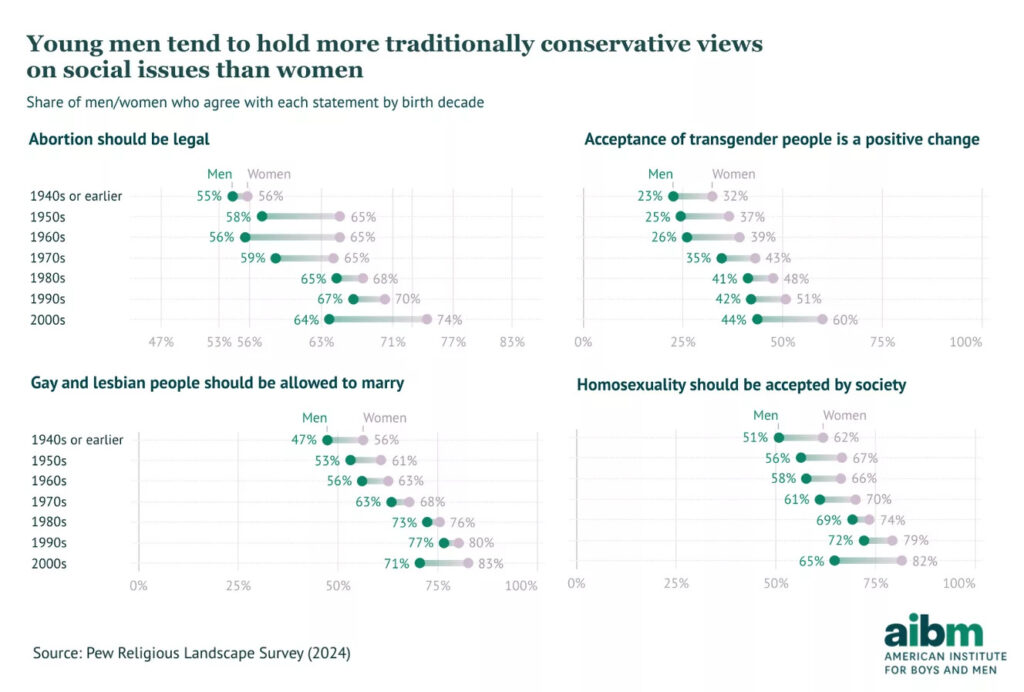
Public polling tells a somewhat different story. First, the views of Gen Z men and women are quite different. In fact, the gender gap on a number of cultural questions is larger among this age group than any other. (If you’re a regular reader of this newsletter, this is not news to you.) A report from the American Institute of Boys and Men found that adults born in the 2000s are not discernibly different in views on abortion or same-sex marriage from men born in the 1980s, but that the largest gaps appear between younger and older cohorts. To translate that into generational terms: Gen Z men are not more conservative on abortion or gay rights than elder Millennials, but they are much more liberal than Gen Xers and Baby Boomer men.
A Trump Effect or a Biden Effect?
During his first term, Trump did not make LGBTQ issues a major priority, but there was some sense that he gave license to those hostile to gay rights to engage in more aggressive and abusive behavior, especially online. But evidence for a first-term Trump effect is limited. In fact, Charlesworth and Finkel found that LGBTQ acceptance peaked in 2020 at the tail end of Trump’s first term. If Trump had effectively stoked anti-gay animus among young people, it wasn’t showing up in public polling either. Gallup found that the percentage of Americans who said same-sex relationships are morally acceptable rose throughout Trump’s first term, only falling after 2022.
A competing explanation is that the public correctly perceived that the political and cultural influence of gay and lesbian people had grown rapidly in recent years. A 2021 Pew survey found that six-in-ten Americans said gay and lesbian people would gain influence under the incoming Biden administration. In fact, few groups were viewed as benefiting more under the new Democratic administration. And among Republicans, no group was perceived to accrue greater influence than gay and lesbian people. By nearly every measure, the Biden administration was the most LGBTQ-inclusive ever, both in terms of personnel and political priorities. What’s more, the administration took pains to publicize these efforts, ensuring that people understood that the voices and interests of LGBTQ people were represented.
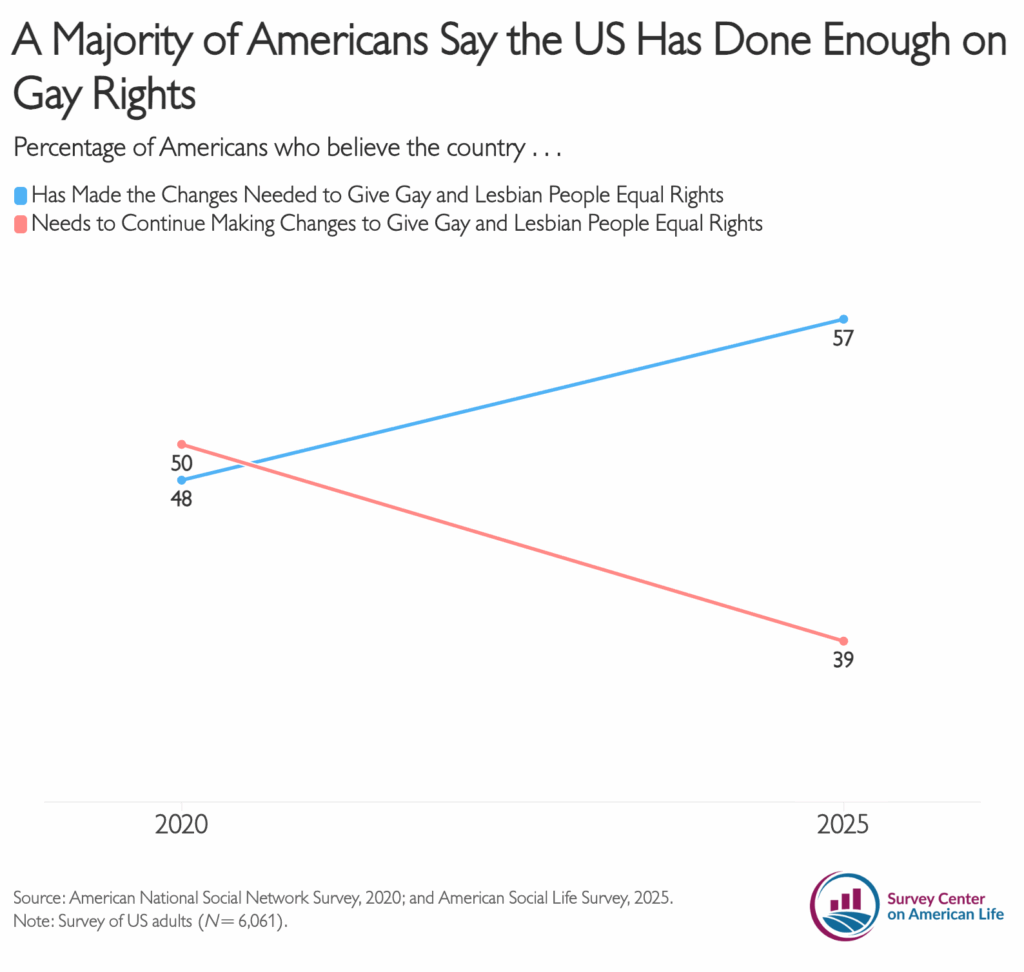
What happened next was probably predictable. If Americans came to believe that gay and lesbian people were well-represented in American cultural and political institutions, their support for aggressive measures promoting LGBTQ equality would necessarily fall. And that’s precisely what occurred. From 2020 to 2025, the percentage of Americans who believe the country needs to do more on gay rights plummeted. In 2020, half of Americans said more needed to be done to ensure gay and lesbian people have equal rights to other Americans. By 2025, that had dropped to 39 percent. This is exactly what one would expect if LGBTQ Americans were perceived as having considerable cultural clout and political representation. What’s more, an acknowledgment that gay and lesbian people have attained greater political influence does not negate their experiences with discrimination. In fact, most Americans can hold these views concurrently. Polls still find that most Americans believe gay and lesbian people experience “a lot” of discrimination.
It’s not only that gay and lesbian people had attained greater political clout, but that they also faced less organized resistance from America’s religious communities. Throughout the late 20th century, influential religious leaders, such as Rev. Jerry Falwell, Pat Robertson, and James Dobson frequently spoke out against the social ills caused by homosexuality. The Catholic Church, the LDS Church and evangelical churches took very public positions against gay rights, investing considerable resources into opposing same-sex marriage. In the early 2000s, most Americans who belonged to a place of worship reported hearing about the issue of homosexuality at church—and the message was overwhelmingly negative. At the time, the power dynamics appeared to strongly favor these well-resourced churches and denominations that were actively and vocally working against the rights of a small group of people who regularly experienced some of the worst forms of bigotry and intolerance.
In the 1990s and early 2000s, young Millennials were regularly exposed to religious messaging that included significant anti-gay content. Roughly one-in-three Millennials raised in religious households left their formative church over the treatment of gay and lesbian people, and many came to associate religiosity with the expression of anti-gay views. For instance, in 2014, seven-in-ten Millennials said anti-gay messaging from religious groups was alienating young people. Over the last decade, religious leaders have talked less about the issue of homosexuality and gay rights (although many have now turned their attention to transgender issues) even if their theological or moral commitments have not changed.
Gen Z came of age at a time that not only saw greater support for LGBTQ people, but far less tolerance for criticism of LGBTQ policies in many leading cultural institutions. It suddenly became normal to include gender pronouns in your email signature and pride flag emojis in social media bios. LGBTQ allies emerged in every corner of the corporate world, and their efforts, while often performative, were highly publicized. Charlesworth and Finkel note: “By 2020, support for gay and lesbian equality had become an establishment position. Corporate America, for example, demonstrated a concrete commitment to gay rights, with companies donating hundreds of thousands of dollars for Pride celebrations and other efforts at gay and lesbian inclusion.” Over the last two decades, Americans increasingly saw evidence of religious decline—even amidst America’s supposed “religious revival,” more than two-thirds of Americans still believe religion is losing influence. Gen Zers grew up in a world where the LGBTQ community held more influence in politics than they once did and where the balance of cultural influence increasingly favored LGBTQ people.
There has been undeniable progress towards greater acceptance of LGBTQ people. Over the last four decades, “the percentage of people who reported they would be very upset if their child were gay or lesbian also dropped from 64 percent to 14 percent.” This is good news! People have become more tolerant and accepting of gay and lesbian people and recognize that public attitudes have become more tolerant and accepting as well. Not everyone agrees about the degree of progress we have made, but it’s clear that we’ve come a long way. Perhaps a natural outcome of this is that it also makes it more difficult to convince voters that LGBTQ inequality is a critical priority.
Young Americans have not abandoned support for gay rights—they fundamentally believe that LGBTQ people deserve respect and equal treatment. Young women in particular are extraordinarily supportive of a wide range of policies pursuing these goals. Young men are more circumspect, not necessarily out of rising antipathy, but perhaps due to questions about necessity. For many LGBTQ people, this shift in public sentiment likely feels demoralizing and disorienting. But rather than representing a new status quo, I think the current landscape on LGBTQ rights is profoundly unsettled. We are not witnessing a collapse in public support, but there has been a recalibration. Public attitudes now vary markedly depending on the issue, the group, and the context. It means the future of LGBTQ rights will be much more difficult to predict.
Read More on American Storylines
Survey Reports



In the news

August 13, 2026
America’s Loneliness Trap


August 6, 2026