
Featured Data March 25, 2025
Share of College-Educated Women in the Democratic Party Has Increased
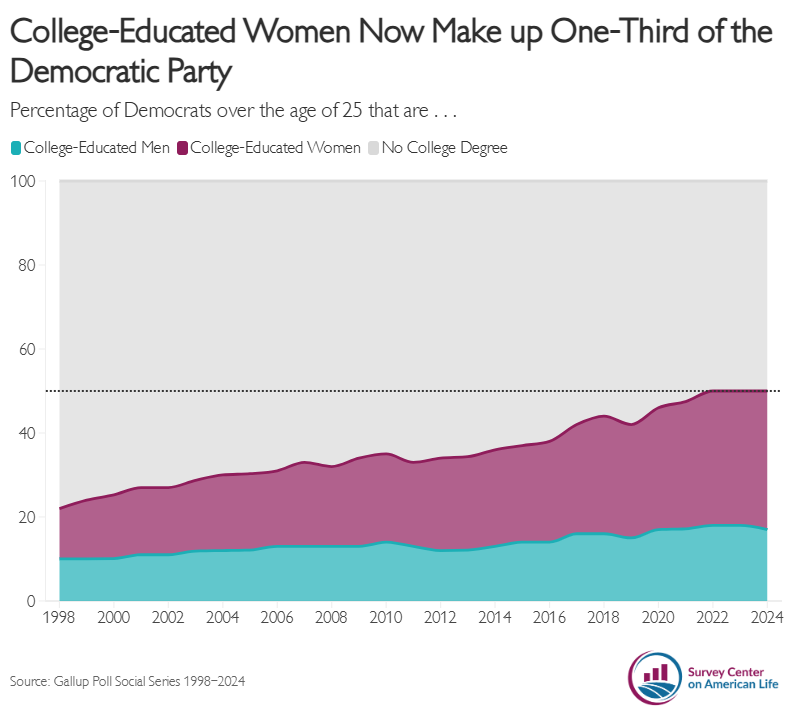
The makeup of the Democratic Party has changed profoundly in recent years. In 1998, a majority (77 percent) of Democrats did not have a college or postgraduate degree. More than two decades later, the party’s composition has shifted dramatically, with college-educated and non-college-educated Democrats now evenly split at 50 percent.
This growing education divide is reshaping the party’s voter base, policy priorities, and political identity. One-third of the Democratic Party consists of college-educated women, a group that is consistently more progressive than most others. The 2024 Democratic Party Platform reflects this shift, catering heavily to college-educated women’s political preferences — whether on climate change and abortion rights or symbolic gestures like land acknowledgements in official meetings. As the Democratic Party continues to prioritize the interests of college-educated women, they may alienate non-college-educated Americans, especially men. In 1998, 19 percent of Democrats were non-college educated men; by 2023, that had dropped to just 12 percent.
As college-educated women increasingly align with the Democratic Party, non-college-educated Americans remain a stronghold for the Republican Party. In 1998, 70 percent of Republicans did not have a college degree, and this has remained the case at 69 percent in 2023. The education divide among the two parties is reshaping America’s political landscape, with each party’s base becoming more distinct not just in ideology, but also in gender and socioeconomic background.
Survey Reports



In the news

May 25, 2026
Can Marriage Survive the Manosphere?

May 23, 2026
Why Americans Are Afraid of Their Neighbors

May 22, 2026