
Strangers Next Door: The Decline of Neighborhood Socializing and the Class Divide in Belonging
Acknowledgment
The American Enterprise Institute’s Survey Center on American Life is grateful to the John S. and James L. Knight Foundation for its generous support of this research.
As Americans spend more of their time online, the neighborhood—once a primary physical location for real-world socialization—is playing less of a central role than ever before. Since the pandemic increased opportunities for remote work and flexible schedules, social interactions among neighbors have fallen. Whether because of social media distractions, travel sports commitments, or the rising use of freelance service providers like Taskrabbit, Americans rely far less on close neighbors and venture out less often into their communities. As Marc Dunkelman contends in The Vanishing Neighbor: The Transformation of American Community, less routine interaction with neighbors and others in the “middle ring” of social connections allows us far fewer opportunities to practice constructive debate.[i]
Neighborhoods vary in size, shape, and character, but one aspect that affects degrees of interpersonal engagement is the educational and class background of the people who live there. Americans with college degrees have a considerable advantage in maintaining close neighborhood connections. College graduates are more trusting of their neighbors—and more likely to socialize with them and work together to solve community problems. Americans with college degrees also express more comfort with leaning on their neighbors for support. For instance, most parents with a college degree say they would feel comfortable asking a neighbor to watch their children in an emergency, while fewer than four in 10 parents without a degree say the same.
It’s not only a class divide. The new American Neighbor survey reveals evidence of a religious gap as well. Those who attend religious services frequently are much more socially active in their neighborhoods than are those who seldom or never participate in religious services. Americans who regularly attend religious services have stronger social connections with their neighbors and are more inclined to work with them to address community problems and concerns. Religious Americans interact with their communities differently, and their views about what it means to be a good neighbor are distinct. They are more likely to believe that good neighbors should seek opportunities to help those who live around them, even if their neighbors did not ask for help.
The American neighborhood was once a primary place for socialization. It included the critical social and civic infrastructure that educated new generations, taught them values, and provided a testing ground for their emerging sense of themselves and the wider world they were joining. The neighborhood is still important, but it occupies a less central place than it once did. Young adults have experienced one of the most rapid declines in neighborly interaction—only one in four say they talk with their neighbors regularly, a drop of more than half in just over a decade.
The State of American Neighborliness
The rise of telework and flexible work schedules created by the pandemic dramatically increased the amount of time Americans spent at home. Even though many Americans have returned to the office after pandemic protocols eased, many still spend considerably more time in and around their immediate homes. Comparisons to a 2012 study by Pew Research Center show that Americans are engaging less with their neighbors than just over a decade ago.[ii]
Although Americans have been spending more and more time in their own neighborhoods, there is little evidence that they are engaging more frequently with the people who live next door. Only 40 percent of Americans report talking to their neighbors regularly (at least a few times a week). This marks a considerable decline in social interaction between neighbors; in 2012, nearly six in 10 Americans (59 percent) said they talked to their neighbors at least a few times a week. In 2025, most Americans interacted with their neighbors sparingly. More than four in 10 (41 percent) Americans talked with their neighbors no more than a few times a month, while 17 percent report that they did not talk to their neighbors at all.
Although the decline in neighborly interactions has occurred among Americans from all backgrounds, the collapse has been far more pronounced among certain groups. Social exchanges between neighbors are much more common among older Americans than among young adults. A majority (56 percent) of seniors report chatting with their neighbors at least a few times a week, demonstrating only a modest seven-point drop from 2012. In contrast, patterns of socializing with neighbors have changed dramatically among young adults over the past decade. Only one in four young adults now report regularly engaging with their neighbors, but in 2012, more than half (51 percent) of young adults said they conversed with neighbors a few times a week or more.
What explains the generational divergence? Older Americans tend to be more settled in their communities than do young adults, having lived in the same neighborhood for a longer period. Homeownership may, for example, provide greater incentives and opportunities for older Americans to develop and maintain social connections with their neighbors.
However, there is no indication that homeownership is associated with more frequent interactions with neighbors. Americans who rent their homes report engaging with their neighbors about as often as do those who own their homes. Similarly, Americans who live in apartments talk to their neighbors at roughly the same rate as those who occupy stand-alone dwellings. The age gap may have more to do with shifting personal priorities and social habits than with a difference in economic circumstances.
That said, marriage may facilitate more frequent neighborly interactions. Married Americans report talking to their neighbors more frequently and experienced a smaller overall decline in these interactions over the past decade. Forty-five percent of married Americans report having talked to their neighbors at least a few times per week in 2025. Among those who have never been married, only 30 percent say the same. Marriage has not always been a reliable indicator for neighborly interactions, however. In 2012, the regularity of social interactions with neighbors looked similar between married and unmarried adults (60 percent vs. 53 percent).
How Do Neighbors Engage?
Beyond striking up a casual conversation, how do Americans engage with their neighbors, and why do they initiate these interactions? Socializing is one of the most common activities reported. Roughly half (51 percent) of Americans say they spent an evening socializing with someone who lives in their neighborhood in the past year. Roughly the same share (53 percent) report they communicated with neighbors via email or text message at some point in the past year. Four in 10 Americans report having worked with people in their neighborhood to fix a problem or improve the condition of their community in the past 12 months.
The Class Divide in Neighborhood Engagement
Class defines our physical existence, influencing where we live, the types of places we call home, and the places we work. It also structures our social lives, from basic interactions with the people in our immediate communities to the trust we have in them. Whether they are socializing with neighbors or taking a walk around the neighborhood, Americans from different educational backgrounds have remarkably distinct experiences.
Americans without a college degree are less engaged in various activities in their neighborhoods. These activities include working with people from their neighborhood to solve problems, spending social time with neighbors, exchanging texts or emails, and walking or running in their neighborhood. Nearly six in 10 (58 percent) college graduates report that they spent an evening with someone in their neighborhood at least once in the past year. Fewer than half (46 percent) of Americans with a high school education or less say the same. Moreover, 46 percent of Americans with a college degree say they have worked with their neighbors to address a problem or improve their neighborhood, compared with only about one in three (34 percent) of those without any college education.
There is an even larger class divide in communication with neighbors. Roughly two-thirds (65 percent) of Americans with a college degree report having sent emails or text messages to their neighbors at some point in the past year. Fewer than half (45 percent) of those without a college degree participate in this activity as often.
Notably, the education divide in neighborly engagement remains consistent across neighborhood types. Americans without a college degree are about as likely to socialize and work with neighbors whether they live in an urban, rural, or suburban neighborhood. In this way, class has become a more robust indicator of Americans’ community experience than has the type of community.
How Helpful Are Neighbors?
Although Americans at large interact with their neighbors less often than they once did, plenty of them remain at least somewhat comfortable relying on their neighbors for support. A majority say they are comfortable asking a neighbor to help them move a piece of furniture (64 percent) or hold on to a set of spare keys (56 percent). Fewer say they would be comfortable relying on neighbors to take care of their pet or watch their child. About half of Americans are comfortable with having a neighbor watch their child for a few hours in an emergency (49 percent) and asking a neighbor to pet sit for a few days (49 percent).
College graduates are generally more comfortable asking for help from neighbors than are those without degrees. For instance, nearly two-thirds (64 percent) of college graduates report feeling comfortable asking a neighbor to keep a set of house keys, while fewer than half (47 percent) of those without a degree say the same. College-educated parents would sooner rely on their neighbors for childcare in an emergency. A majority (56 percent) report that they would feel comfortable leaving their kids with a neighbor, while fewer than four in 10 (39 percent) parents without degrees said the same.
There is a notable wrinkle in this pattern, with fathers reporting greater comfort than mothers across the education divide. About half (51 percent) of college-educated mothers—and more than six in 10 (62 percent) college-educated fathers—say they would feel comfortable asking a neighbor to watch their children for an hour or so in an emergency. Mothers without a college degree are far less comfortable relying on neighbors for this type of help: Fewer than one in three (32 percent) report feeling comfortable asking a neighbor to watch their child for a short time.
Housing type may not affect how frequently neighbors interact, but it is associated with how comfortable Americans are leaning on their neighbors for help. Americans living in detached single-family houses express the most comfort with asking neighbors for help, while apartment dwellers are among the least comfortable doing so. For instance, more than six in 10 (63 percent) Americans living in a stand-alone house say they would be comfortable having a neighbor hold on to a set of their spare keys, while only 41 percent of Americans living in an apartment say the same. Americans who reside in single-family homes also report being more comfortable than those in apartments asking a neighbor to look after their pet (55 percent vs. 39 percent).
There are also pronounced generational divisions in asking—and therefore receiving—help from neighbors. Younger Americans express greater hesitancy when it comes to relying on their neighbors. Nearly half of Americans say they would be comfortable asking a neighbor for child or pet care. Most young adults, in comparison, say they would be uncomfortable asking this of their neighbors. Sixty-four percent of all adults say they would be comfortable asking a neighbor for help moving furniture; Americans over age 30 are 10 percentage points more likely than young adults to say they are open to this.
The largest gap appears in Americans’ comfort in sharing a set of keys with their neighbors. Six in 10 adults over age 30 say they would be comfortable with this, while only 36 percent of young adults say the same. This pattern holds across housing types; older homeowners are significantly more comfortable having a neighbor hold their keys than are younger homeowners.
What Does It Mean to Be a Good Neighbor?
Against a backdrop of rising social isolation, most Americans believe that being a good neighbor is more about keeping your distance than about engaging with the people living nearby. Roughly two-thirds (65 percent) of Americans believe that being a good neighbor means “not getting too involved in your neighbors’ personal affairs.” Only one-third of Americans believe it is more about rendering help and support even if these are not asked for.
Views on neighborliness vary somewhat between older and younger Americans. Young adults are significantly more likely than seniors to say being a good neighbor is about not getting involved in others’ affairs (70 percent vs. 57 percent). More than four in 10 seniors (41 percent) say being a good neighbor means trying to help without having to be asked.
Religious Americans tend to have different conceptions of neighborliness as well. Close to half (45 percent) of Americans who attend religious services multiple times a week say being a good neighbor requires engaging with the people who live around you even if they do not request it. Only about half (52 percent) of Americans who attend religious services more than once a week say keeping your distance from others is what makes a good neighbor, a view shared by nearly three-quarters (73 percent) of those who never attend services.
Community Conflict and Neighborhood Trust
Neighbor Disputes
Disputes between neighbors are not uncommon, but most Americans manage to avoid problems with the people living next door. Roughly one in four (26 percent) Americans report that they have had a dispute with a neighbor, but fewer than one in 10 (9 percent) say this occurred in the past 12 months. There is no clear pattern across basic demographics in the likelihood of getting crosswise with a neighbor. There are no differences by political affiliation, educational attainment, gender, age, or housing type.
The types of altercations between neighbors vary widely. To explore the contours of conflict between neighbors, the survey included an open-ended question asking respondents who had experienced a disagreement with a neighbor to describe the dispute’s nature.
For many Americans, the most common neighborhood conflicts involved loud noises. Twenty-three percent of Americans who have experienced conflict with their neighbors said it was related to noise disturbances. Some complained of unruly or noisy children, like one 22-year-old man who shared: “The upstairs neighbor has a kid running around a lot and stomping. It is very irresponsible for the parent to let it happen.” Many others described disputes over parties and loud music. As a 63-year-old man recalled, “We were having a cookout and the neighbors were complaining about the music.”
A considerable portion of neighborhood complaints involve pet behavior (19 percent), specifically dogs. Many complaints involve dogs that bark excessively, bite, or attack other pets and children. A few respondents mentioned the improper disposal of animal waste, especially when it wound up in their own yard. In several instances, individuals reported their pets being killed because of a neighbor’s negligence. One 74-year-old man reported that his neighbor was a dog breeder. “He raises pit bulls in the yard, and they get loose when hungry. They mauled and killed one of my beloved dogs. He refuses to pay the vet bill.”
An identical share (19 percent) of neighborhood disputes centered on property lines, particularly involving construction, fences, and encroachment onto neighboring land. Some disputes resulted from unkempt properties, lawn care, and junk or clutter on or within sight of one’s property. Other types of conflicts that Americans commonly experienced included interpersonal problems and harassment (15 percent), maintenance and upkeep (11 percent), and parking disputes (9 percent).
Neighborly Disputes: In Their Own Words
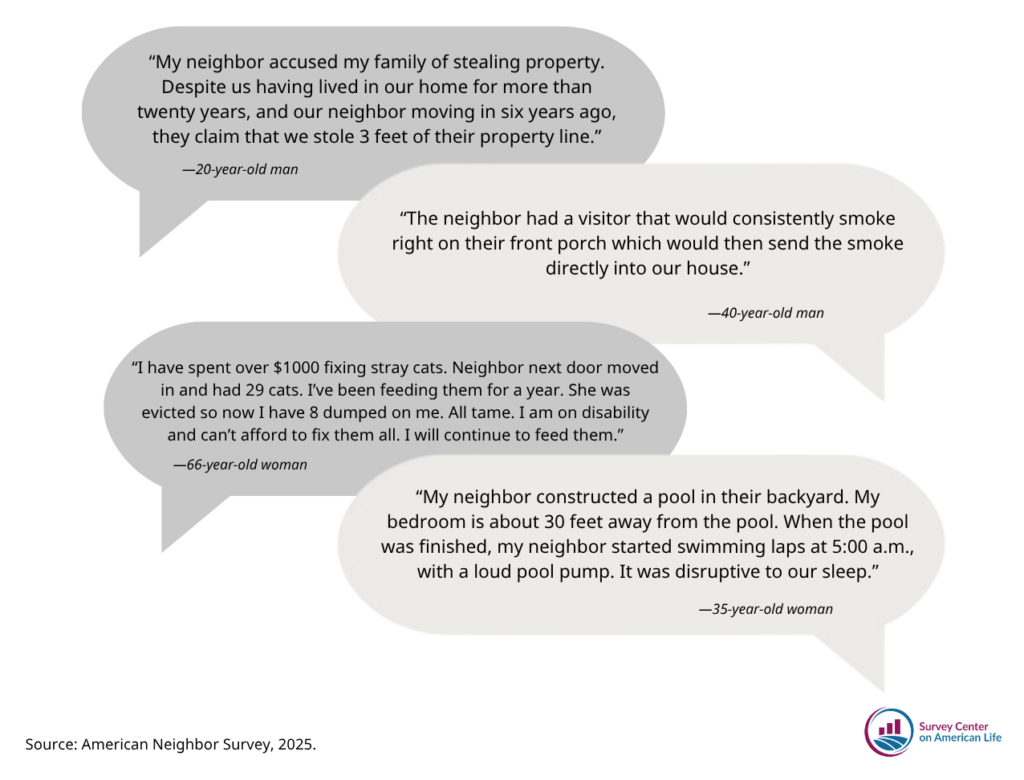
Numerous Americans who had disagreements with their neighbors complained about people being too involved in their personal affairs for their comfort. Some complained of “Karens” living next door. For example, one 60-year-old man shared that his late neighbor was “too damn nosey!!! By the way, he’s dead now!! Good riddance!!!”
Trust in Neighbors
Despite the challenges some Americans have with their neighbors, most Americans express a reasonable amount of trust in the people who live around them. More than seven in 10 (72 percent) Americans report having a great or fair amount of trust that the people in their neighborhood do the right thing. Roughly one in four (26 percent) report having little or no trust in their neighbors. Much like the comfort we have in relying on our neighbors for support, socioeconomic status is closely associated with Americans’ degree of trust in the people next door. Americans with more years of formal education express greater trust in their neighbors, perhaps reflecting higher overall levels of social trust or the character of their neighborhoods. Sixty-four percent of those with a high school degree or less say they trust their neighbors a fair amount or a great deal, while more than eight in 10 (81 percent) college graduates say the same.
Dwelling type and ownership status are also associated with trust among neighbors. Americans who own their homes report higher levels of trust. Nearly eight in 10 (79 percent) homeowners trust their neighbors to do what is right, while only 56 percent of renters feel the same way. Housing type is also associated with neighborly trust, with the highest levels of trust among those living in detached single-family homes. Meanwhile, Americans living in apartments report the least trust in their neighbors.
Navigating Neighborhood Politics
Americans demonstrate varying degrees of comfort when faced with the possibility of different neighbors. Most Americans prefer to have neighbors whose values and views align with their own, although the strength of these preferences varies among groups. For example, most Americans say they would be comfortable having someone who is transgender move next door. Not surprisingly, liberals are more likely than conservatives to exhibit comfort with having a transgender neighbor (88 percent vs. 41 percent). Meanwhile, 57 percent of conservatives say they would be uncomfortable if someone who is transgender moved in next door.
Similarly, most Americans (57 percent) say they would be comfortable having a neighbor who strongly supports Donald Trump, while 40 percent say they would be uncomfortable if an ardent Trump supporter moved next door. As expected, conservatives report being much more comfortable with this possibility, with over eight in 10 (83 percent) saying they would have no problem with it. A slightly smaller share of liberals (74 percent) say they would be uncomfortable having a next-door neighbor who was an avid Trump supporter.
Notably, liberals report being much less comfortable living next to a Trump supporter than conservatives say they would be about having a neighbor who strongly opposes the president (52 percent). Clearly, tolerance toward their neighbors is the default for a slim majority of Americans. Ideological divisions remained pronounced, however, with liberals expressing somewhat more social aversion toward neighbors with whom they disagree politically.
Personal politics is not the only factor that may influence Americans’ degree of comfort with certain types of neighbors. The broader community’s political landscape may play a role as well. Liberals who live in communities where most people or nearly everyone voted for Trump are more comfortable with having a next-door neighbor who strongly supports the president. One in three (33 percent) liberals who live in a community with many Trump supporters say they would be comfortable if a Trump supporter moved in next door. In contrast, only 14 percent of liberals in communities where many if not most people supported Kamala Harris in 2024 say they would be comfortable with a next-door neighbor who supports Trump.
The same pattern is evident among conservatives in their relative comfort with a transgender person moving in next door. Conservatives in communities with many Harris supporters are significantly more comfortable having a transgender neighbor than are those who live around mostly Trump supporters (50 percent vs. 36 percent).
Notably, a neighborhood’s political character does not seem to predict conflict between neighbors or influence how trusting Americans are of the people who live next door. Liberals who live in communities with many Trump supporters are not any more likely to report having a dispute with their neighbor than are liberals who live in places with mostly Harris supporters. The pattern among conservatives is nearly identical.
What Facilitates Neighborly Interactions?
Walking (with or Without a Dog)
Being out and about is a good way to meet your neighbors. One of the strongest predictors of neighborly interaction is also the most obvious: spending time in the neighborhood. Americans who report that they take walks or run through their neighborhood are much more likely to converse with neighbors. A majority (55 percent) of Americans who walk around their neighborhood at least once a week say they talk to their neighbors at least a few times a week. Americans who walk less often report much less neighborly interaction. The share of Americans who talk with their neighbors at least weekly is only 29 percent among those who walk only once or a few times a year and 19 percent among those who do not walk around their neighborhood at all.
Dog ownership is also associated with increased social engagement with neighbors, but only for those who walk their dog. Half of Americans who own a dog and walk it regularly report that they talk with their neighbors at least a few times a week. In contrast, only 33 percent of dog owners who do not walk their pets say they talk to neighbors this often.
Neighborhood Amenities and Civic Spaces
Public and commercial places play a unique role in binding communities together by providing opportunities for residents to spend time together. American communities include various public and commercial amenities, such as restaurants, gyms and fitness centers, public parks, libraries, and community centers. These “third places” are where Americans can go in their nonworking hours to spend time in the community.
The types of amenities in American communities vary. The most common nearby third places serve important community needs. These places include grocery stores (66 percent), schools (62 percent), and public parks and community gardens (62 percent). At least half of Americans also live close to churches or other places of worship (60 percent), bars or restaurants (57 percent), and coffee shops (50 percent). Fewer than half of Americans have access to gyms or fitness centers (39 percent), local libraries (37 percent), or community centers (29 percent).
The vast majority of Americans report having at least a few places within a 20-minute walk from their house where they can interact with their neighbors, and over seven in 10 Americans have three or more such places. Twenty-seven percent of Americans have access to three to five amenities, while over four in 10 (44 percent) have access to six or more amenities within walking distance. A noteworthy share of the American public, however, has limited access to neighborhood amenities: 20 percent have access to only one or two spaces, while one in 10 Americans have access to none.
Americans with less formal education are more likely to live in places with fewer third spaces. Only 37 percent of Americans with a high school degree or less report having six or more public gathering places in their community. Similarly, more than one-third of Americans without a degree have access to only one or two third spaces. More than one in 10 have access to none. In contrast, nearly half of college graduates have six or more neighborhood amenities within a 20-minute walk from where they live.
Notably, the education gap tends to be more pronounced when it comes to access to commercial spaces than public amenities, such as schools and libraries. Americans with a high school degree or less are far less likely than college graduates to report having access in their local community to coffee shops or cafes (43 percent vs. 57 percent), bars or restaurants (50 percent vs. 63 percent), and gyms or fitness centers (32 percent vs. 46 percent). The education divide is much more modest regarding access to houses of worship, community centers, and libraries.
Third places are cornerstones of vibrant, connected communities. Access to places that facilitate neighborly interactions substantially affects how often Americans talk to their neighbors and how they feel about their community overall. Those who report having no third places in their community are considerably less likely to have regular conversations with people from their neighborhood than are those who have six or more such places. Fewer than three in 10 (27 percent) Americans with no public places in their neighborhood have a conversation with a neighbor a few times a week or more, compared with 43 percent of those with six or more such places nearby.
Americans with more third places in their community are more likely to take frequent walks around their neighborhood. Only 18 percent of those who have no third places nearby report taking walks around their neighborhood once a week or more, compared with 45 percent of those with six or more such places.
How Religious Involvement Shapes Community Interactions and Values
Americans who regularly attend religious services report stronger connections to their neighbors than do those who attend infrequently or not at all. Frequent religious participation is associated with increased interaction with neighbors, more time socializing with neighbors, and a more active lifestyle in and around neighborhoods.
Americans who regularly attend religious services report more frequent interactions with their neighbors. Nearly half of Americans (49 percent) who attend religious services at least once a week say they talk with their neighbors a few times a week or more, compared with just over a third (35 percent) of those who seldom or never attend services. Those who rarely or never attend services are more likely to have no interaction with their neighbors. Only 12 percent of weekly attendees report never talking to their neighbors, compared with 22 percent of those who seldom or never attend services.
This pattern is particularly pronounced among young adults. Americans age 18 to 29 who attend religious services weekly or more often are twice as likely as those who attend seldom or never to have weekly conversations with their neighbors (40 percent vs. 20 percent). Among older Americans, the gap in neighborly interactions between those who attend services weekly and those who attend infrequently is much more modest (59 percent vs. 52 percent). Among young adults, those who seldom or never attend services are 17 percentage points more likely than weekly attendees to report having no regular interaction with their neighbors. This gap is negligible for older Americans: Only 6 percent of regular attendees and 10 percent of non-attendees report not speaking with their neighbors.
Regular religious service attendees are more likely to not only converse with their neighbors but also dedicate time to socializing and working with their neighbors to solve community problems. Over four in 10 (43 percent) frequent attendees say they spent a social evening with someone in their neighborhood at least several times a year, compared with 32 percent of those who seldom or never attend. Among regular attendees, nearly three in 10 report working with people from their neighborhood to fix a problem annually or more often. Only 16 percent of those who rarely or never attend services say the same. In fact, infrequent attendees and non-attendees are far more likely to report never working with their neighbors to address problems than are those who regularly attend services (67 percent vs. 51 percent).
In addition to being more socially and civically active in their communities, frequent religious attendees are more physically active. Among weekly attendees, 59 percent report taking walks around their neighborhood at least several times a month, compared with just under half of those who attend seldom or never.
Americans have a wide range of preferences regarding what they want from their ideal community. A vast majority of Americans (88 percent) want people in their community to look out for each other. At the same time, 79 percent want to live in a community where people generally mind their own business. Seventy-three percent of Americans want to live in a place with a strong sense of community, and 62 percent want most people in their community to have traditional values. Most Americans (53 percent) prefer their community to be racially and ethnically diverse, and 52 percent want to live close to their extended family. In general, living in a place where people share their political views is less important to Americans; only 36 percent say this is important.
What Americans value in a community differs significantly between those who are religious versus nonreligious and much less across religious traditions. Religious Americans are more likely than their nonreligious counterparts to prioritize living near their extended family: 57 percent of religious respondents say this is important, compared with 41 percent of unaffiliated Americans. Religious Americans are much more likely than their religiously unaffiliated counterparts to say living in a community with traditional values is important (71 percent vs. 40 percent). They also tend to prioritize living in places with a strong sense of community, whereas secular Americans care more about having a diverse community. More than three-quarters (77 percent) of religious Americans feel it is important to live in a place with a strong sense of community, while only 63 percent of unaffiliated Americans agree. Notably, roughly equal numbers of religious and nonreligious Americans say living in a community where people look after each other is important (90 percent and 86 percent, respectively).
Conclusion
The decline in social engagement among neighbors is not an anomalous trend; it is likely connected to the larger deterioration of American social life. Americans have fewer close friends than they once did and spend fewer hours socializing. This same trend is showing up in the American neighborhood. Over the past decade, the frequency of neighborly interactions has plummeted. Relatively few Americans report socializing with their neighbors, although the drop has had a larger effect on some communities than on others.
The American Neighbor Survey reveals a pronounced class divide in social engagement. Americans with less formal education have experienced the sharpest decline in neighborhood social experiences. They have fewer social outlets and are less able to rely on their neighbors for critical support. Only about one in three noncollege mothers feels comfortable relying on a neighbor to watch their children in an emergency.
One reason for the disparity may be a lack of access to many of the social infrastructures that foster conversation and community with our neighbors. Access to neighborhood amenities, such as coffee shops, public parks, and community centers, provides more opportunities to meet with neighbors and cultivate a sense of belonging. College-educated Americans are more likely to live in neighborhoods with easy access to these critical social spaces.
Social disparities in neighborly interactions are attributable not only to class differences. Regular involvement in a place of worship is associated with much more frequent social interactions with neighbors. It’s not only about getting out more often into the community; religious Americans have different expectations about the relationships we should have with the people who live next door. When being a neighbor is about more than respecting others’ privacy, being part of a neighborhood takes on another meaning as well.
About the Authors
Daniel A. Cox is the director of the Survey Center on American Life and a senior fellow in polling and public opinion at the American Enterprise Institute (AEI). Under his leadership, the center focuses on public opinion and survey research on a variety of topics, including the emerging gender divide among young adults, dating and relationships, and social connection. Before joining AEI, he was the research director at Public Religion Research Institute, which he cofounded and where he led the organization’s qualitative and quantitative research program.
Jae Grace is a research assistant at AEI’s Survey Center on American Life.
Avery Shields is a research assistant at AEI’s Survey Center on American Life.
Methodology
AEI’s Survey Center on American Life designed and conducted the survey. Interviews were conducted among a random sample of 5,357 adults (age 18 and up). All interviews were conducted among participants in the Ipsos KnowledgePanel, a probability-based panel designed to be representative of the US general population, not just the online population. Interviews were conducted in Spanish and English between October 10 and October 17, 2025.
The Ipsos KnowledgePanel recruitment process employs a scientifically developed address-based sampling methodology using the US Postal Service’s latest Delivery Sequence File—a database that fully covers all delivery points in the US. Households invited to join the panel are randomly selected from all available US households. Persons in the sampled households are invited to join and participate in the panel. Those selected who do not already have internet access are provided a tablet and internet connection at no cost to the panel member. Those who join the panel and who are selected to participate in a survey are sent a unique password-protected log-in to complete surveys online.
Because of these recruitment and sampling methodologies, samples from KnowledgePanel cover all households regardless of their phone or internet status, and findings can be reported with a margin of sampling error and projected to the general population. KnowledgePanel members receive a per-survey incentive, usually the equivalent of $1 (though for some it is $2) in points, that can be redeemed for cash or prizes. Panelists receive a unique log-in to the survey and can complete it only once. Two reminder emails were sent for this study.
The data were weighted to adjust for gender, race and ethnicity, education, census region, household income, language dominance, race by age, race by education, and 2024 presidential vote. The sample weighting was accomplished using an iterative proportional fitting process that simultaneously balances the distributions of all variables. The use of survey weights in statistical analyses ensures that the demographic characteristics of the sample closely approximate those of the target population. The margin of sampling error for the qualified survey sample is +/–1.55 percentage points at the 95 percent level of confidence. The design effect for the survey is 1.35.
Notes
[i] Marc J. Dunkelman, The Vanishing Neighbor: The Transformation of American Community (W. W. Norton, 2014).
[ii] Pew Research Center, “Assessing the Representativeness of Public Opinion Surveys,” 2012, https://www.pewresearch.org/politics/2012/05/15/assessing-the-representativeness-of-public-opinion-surveys/.
Generation Uncoupled

Generation Uncoupled: America's New Gender Divide and the Crisis of Human Connection
Buy NowRelated Materials
Survey Reports