
A Digital Divide in American Adolescence: Gender, Class, and the New Teenage Experience
If teenage years once represented a time of rebellion, teenagers’ lives today are marked less by pushing boundaries and more by building their own. Many teenage experiences are less common than they once were—dating, working a part-time job, and experimenting with drugs and alcohol are less common experiences. The 2026 American Teenagers Survey from the American Enterprise Institute’s Survey Center on American Life shows that a substantial number of teenagers (age 13 to 17) are opting out of more traditional teen experiences. They do not regularly eat meals with their family, attend religious services, read, or spend time with friends. Many are still satisfied with their lives even as they are pessimistic about the state of the country and express worries about their future.
Technology has played an outsized role in reshaping American adolescence. How teens think about their future is shaped by the time they spend online, and most spend a considerable amount of time on social media. On average, teens spend at least 2.8 hours a day on social media[i]—with a significant minority spending a good deal more time on these platforms.
Early proponents of the internet and social media argued these technologies would be democratizing forces. By bypassing traditional information gatekeepers, they would narrow the educational divide and give ordinary people direct access to a variety of tools and resources. Rather than relying on traditional institutions such as higher education and news media, Americans with less formal training and education could access spaces previously denied to them. Social media would connect us all and in so doing reduce prejudice, intolerance, and bigotry.
It has not quite worked out this way. There is mounting evidence that the increased efficiency and access that smartphones and social media have offered have come with substantial adverse effects. The American Teenagers Survey offers new evidence to the debate over the benefits and risks that have come with the rapid adoption of emerging social and AI technologies. Teen girls spend far more time on social media than boys do and, perhaps as a result, more directly experience the attendant costs. The survey shows that teen girls who are more active on social media platforms are less optimistic, less excited about their lives, and less satisfied with their school. These same patterns do not hold for teen boys.
The survey not only reveals concerning associations between social media use and negative personal evaluations but also finds that parents’ education levels shape the way kids engage with social media—the amount of time they spend online, the number of apps they visit, and their attempts to take social media breaks. Teens raised by parents without college degrees are spending much more time on social media and logging many more hours playing video games than their peers. More than one in three teenage boys with non-college-educated parents report spending four or more hours each day gaming.
The Lives of American Teenagers
American teenagers are growing up during a time of considerable pessimism. Most Americans feel gloomy about the direction the country is headed in; express limited confidence in major social, cultural, and political institutions to serve the public interest; and doubt their own ability to thrive at a time of considerable economic upheaval. Nearly six in 10 (58 percent) American teenagers (age 13 to 17) believe America’s best days are behind it. Only about four in 10 (41 percent) believe that the best is yet to come.
Teens may not be overly optimistic about where things are headed, but few are expressly dissatisfied with the way things are going in their lives. Half of American teenagers report being very or completely satisfied with their lives. Roughly one in three (34 percent) report they are somewhat satisfied with their lives thus far; only 16 percent say they are not too satisfied or not satisfied at all.
A similar share of teens are as satisfied with their school and personal health as they are with their lives in general. Roughly half of teenagers report that they are very or completely satisfied with their school (47 percent) and their personal health (50 percent). Few teenagers report being dissatisfied with either. These self-reported evaluations of health and views about schools are fairly consistent between girls and boys and across different racial and ethnic backgrounds.
American teenagers are generally satisfied with their relationships with their parents. Roughly two-thirds (65 percent) say they are either very satisfied or completely satisfied with these relationships. One in four teenagers say they are somewhat satisfied, and one in 10 say they are not satisfied with these relationships.
Most teenagers feel quite satisfied with their friendships as well. Six in 10 say they are very or completely satisfied with the number of friends they have. Twenty-nine percent say they are somewhat satisfied, and only one in 10 say they are not satisfied with how many friends they have.
Overall, the teens who express the most satisfaction with their lives are younger teen boys (age 13 to 15), while older teen girls (age 16 and 17) report the lowest feelings of satisfaction. Nearly six in 10 (58 percent) younger teen boys report being very or completely satisfied with their lives. Only four in 10 (40 percent) older teen girls say the same. Meanwhile, older teen boys and younger teen girls are about as satisfied with their lives as teenagers overall.
Teens’ assessments of their friendships vary along similar lines. Younger teen boys are the most satisfied with how many friends they have, while older teen girls are the least. Sixty-six percent of younger teen boys say they are very or completely satisfied with the number of friends they have, compared with only half of older teen girls.
There is a stark divide between how teens with college-educated parents evaluate their schools and how those whose parents lack a four-year degree evaluate them. A majority (55 percent) of teenagers with college-educated parents report being very or completely satisfied with their school, while only 40 percent of teens whose parents did not go to college said the same.
Teenagers with Divorced Parents
Few circumstances are more strongly associated with teenagers’ well-being than parental marital status. Only 37 percent of teenagers whose parents are divorced report that they feel very or completely satisfied with how things are going in their lives. In contrast, a majority (55 percent) of teenagers with married parents report being very or completely satisfied with their lives.
This is not the only gap between teens with divorced and married parents. Compared with teenagers with married parents, teens with divorced parents report lower evaluations of their personal health (54 percent vs. 37 percent) and less satisfaction with the relationship they have with their parents (71 percent vs. 56 percent).
Older Teen Girls Are Less Excited About Their Lives
Despite the challenges many teenagers face, most still report regularly feeling excited about their lives. Nearly two-thirds (64 percent) of teenagers say they feel excited about their life at least multiple times a week.
There is, however, a notable age divide. Younger teenagers generally express more frequent excitement about their lives than older teens do, but the divide is most pronounced among girls. Approximately seven in 10 younger teen boys (72 percent) and younger teen girls (68 percent) say they feel excited about their life at least a few times a week. Sixty-four percent of older teen boys report feeling this way as often. Among older teen girls, less than half (48 percent) say they feel this way at least a few times a week.
Family and Home Life
Regular family dinner is not routine for many of today’s teenagers. Only 37 percent of American teenagers say they share meals as a family every day. Twenty-nine percent report that they have family meals a few times a week, and one in three (33 percent) say this occurs no more than once a week.
Younger teenagers report having meals with their family more regularly than do older teens. Forty-four percent of younger teens say they have family meals every day, a significantly more frequent occurrence than among older teens: Only 28 percent of older teens say they have daily meals with their family.
Household chores are a fairly regular part of teens’ weekly routines. More than one in four (28 percent) teenagers report doing household chores—such as cooking, cleaning, and doing laundry—daily. About one in three (35 percent) say they help around the house a couple of times a week, while 16 percent say they engage in chores only once a week. Roughly one in five teenagers do household chores less than once a week. Notably, teen boys are somewhat more likely than teen girls to report doing daily chores (33 percent vs. 23 percent).
As for leisure activities, few teens regularly read for pleasure. Only around one in three (34 percent) teenagers report that they have read a book for fun in the past week. Just as many report reading for enjoyment only once or twice a month or a few times in the past year. Thirty percent of teenagers say they seldom or never read for fun.
Reading is also a highly gendered activity among teenagers. Younger teenage boys are the least likely to pick up a book to entertain themselves. More than one in four (26 percent) younger teen boys say they never read a book for pleasure—more than three times the rate reported by their female peers of the same age.
Reading isn’t the only extracurricular teens are participating in less often than they used to.[ii] Today’s teenagers are not that religiously active either, though a substantial minority report attending services regularly with their families. One-third of teenagers say they attend religious services with their family at least once a week. One in four say they attend once in a while (once or twice a month to a few times a year). Forty percent of teenagers seldom or never attend religious services with their families.
Religious participation varies widely among teenagers of various family arrangements. Nearly four in 10 (38 percent) teenagers with married parents attend religious services weekly with their parents, compared with only 19 percent among those whose parents are divorced. Nearly half (47 percent) of teenagers with divorced parents say they seldom or never attend worship services with their family.
Few teens participate less often in religious worship than older teenage girls. Close to half (47 percent) of older teen girls report that they rarely, if ever, attend services with their family; more than one in three say they never do. This is a substantial difference from younger teen girls and older teen boys. Among younger teen girls, only 20 percent report that they never attend religious services. Among 16- and 17-year-old boys, about four in 10 rarely attend services.
Pastimes and Extracurricular Activities
Many teens report they are not reading, going to religious services, or sharing meals with their families regularly. But these aren’t the only activities that have become less common.[i] Four in 10 report that they play travel sports. Fewer teens are involved in music, art, or academic pursuits. Only one in five teenagers report that they are a member of choir, band, or orchestra, and just 14 percent take private music or dance lessons. About one in five teens (18 percent) report that they are a member of an academic club, and 7 percent of teens are involved in student government or a debate team.
Fifteen percent of teenagers report having a part-time job, with rates substantially higher among older teens. Close to three in 10 (28 percent) older teens report having a part-time job. Notably, older teen girls are more likely to be working a part-time job than older teen boys are (32 percent vs. 24 percent).
When it comes to athletics and music, participation declines with age. A majority (52 percent) of younger teenage boys report participating in a travel sports league, compared with only about one-third (35 percent) of older teenage boys. The decline among girls is far more modest. A similar although less pronounced decline in music participation occurs among girls. Thirty percent of younger teenage girls report participating in choir, band, or orchestra, compared with only 17 percent of older teen girls. Teen boys also participate less in music as they get older. That gap is, however, less pronounced than it is among younger and older teen girls.
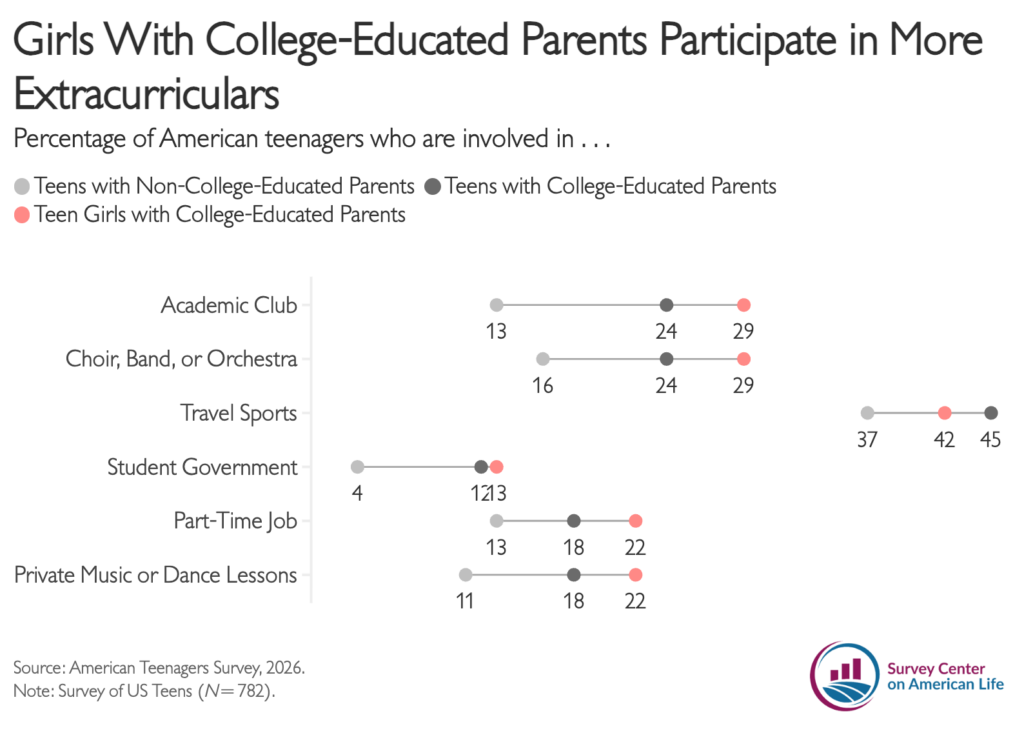
In addition to age, parental education levels shape how teens engage in extracurricular activities. Teens with college-educated parents tend to participate in a greater range of activities than those whose parents do not have a four-year college degree do. For instance, nearly one in four teens—including 29 percent of teen girls—with college-educated parents report participating in an academic club, compared with 13 percent of teens whose parents did not graduate from college. Teens with college-educated parents are also three times as likely to participate in student government or debate as those with less educated parents (12 percent vs. 4 percent).
With an expanding list of extracurriculars to participate in, teens live more scheduled lives now than ever before. Only 28 percent of teens say that they get at least eight hours of sleep every night. Forty-one percent say they get this much sleep a few times a week. Three in 10 teenagers report getting eight hours of sleep no more than once per week.
Whom Do Teens Turn to for Help?
When teenagers face personal problems, there is one person they turn to more often than anyone else: Mom. Forty percent of teenagers say their mother is the person they usually turn to first when facing a personal problem. After their mothers, the next-most-common person that teens mention as a source of support is a friend. About one in four (24 percent) teens say they seek out a close friend first when confronting a challenging personal situation. Eight percent say they turn to a sibling, and only 6 percent report that they first come to their father for help with a personal problem. One in 10 teens say they do not have anyone to turn to for help managing a personal challenge.
Overall, teen girls are somewhat more likely to turn to their friends for help with a personal problem than are teen boys (28 percent vs. 20 percent), but there is a notable age divide. Nearly one in three (32 percent) older teen girls say they first turn to their friends for help, compared with a quarter of younger teen girls and older teen boys. Younger teen boys are the least likely to seek solace in their friends—only 17 percent report doing this.
In school, there is a stark gender divide in perceptions of who receives teachers’ and administrators’ support and encouragement and who does not. A majority (55 percent) of teen boys say that girls at their school receive more encouragement and support than boys do. Only 37 percent of teen girls agree with this assessment.
Spending Time with Friends
Adolescence is a period when peers have historically taken on more central roles as providers of emotional and social outlets. However, not only are today’s teens less likely to rely on friends for help, but notably, they do not spend a great deal of time with their friends outside the normal school day. While a small majority (55 percent) of teenagers spend time with their friends outside school hours at least once a week, more than four in 10 (44 percent) do not see their friends outside school more than once or twice a month. Fourteen percent say they seldom or never hang out with their friends in their free time.
This lack of socializing does not appear to be the result of teenagers lacking friendships. Only 2 percent of American teens say they have no close friends. Over a third (34 percent) of teens say they have one to three close friends. Sixty percent of teenagers report that they have at least four close friends, which is more than adults overall.[iv]
Technology in Adolescence
New technologies have fundamentally changed adolescence. Social media and now AI chatbots have altered the way teens communicate with one another and how often they interact face-to-face.
A Class Divide in Social Media Use
American teenagers spend hours online each day, with apps such as YouTube and TikTok dominating their attention. Thirty-five percent spend at least four hours a day on social media or playing video games. The amount of time teens spend engaged in these activities varies across households. The survey finds that teen girls raised by parents without college degrees are on more social media apps, spend more hours using them, and are less inclined to cut back than girls whose parents went to college, while among boys, the same divide emerges in the hours spent gaming.
The class divide in social media use may exacerbate existing inequalities instead of reducing them. Among teen girls, more active social media engagement is associated with negative personal outcomes, including less sleep, lower rates of reading, and lower feelings of personal satisfaction.
The majority of teenagers are spending multiple hours on social media every day. About four in 10 (39 percent) spend three or more hours of their day online. YouTube and TikTok are the most popular social media platforms teens visit. More than seven in 10 (72 percent) spend time on YouTube every week, while six in 10 say the same of TikTok. Gaming also eats up a significant portion of teens’ free time, although less so than social media. More than four in 10 (44 percent) teens spend at least an hour gaming every day.
Teen girls raised in less educated households are more likely to use Instagram (66 percent vs. 57 percent), Snapchat (49 percent vs. 44 percent), Facebook (31 percent vs. 15 percent), and X (12 percent vs. 6 percent). The education gap is largest in TikTok use. Nearly three-quarters (73 percent) of teen girls raised by parents without college degrees spend time on the app, compared with only about half (53 percent) of teen girls whose parents have college degrees. There is also a significant difference in the number of apps they use.[v] Forty-one percent of teen girls with non-college-educated parents report using at least four different social media apps, compared with 25 percent of teen girls raised by college-educated parents.
This same gap is also evident in the amount of time teen girls spend on social media. About one in five (21 percent) say they spend between one and two hours on social media every day. Thirty-nine percent of teens report they spend less than an hour a day or do not use social media at all. Teen girls whose parents did not go to college, however, log more hours on social media than any of their peers. Nearly half (49 percent) of teen girls raised by parents without a college degree report spending three or more hours a day using social media, compared with 36 percent of teen girls with college-educated parents.
Parental education is also correlated with teens’ efforts to reduce their screen time. Among girls, those raised in households with parents of higher education levels are more likely to report attempting to reduce their time spent online. Nearly six in 10 (58 percent) teen girls raised by college-educated parents say they have tried to reduce their social media activity in the past 12 months. In contrast, only 40 percent of teen girls who have non-college-educated parents report attempts to lessen their social media activity.
There is no evidence of the same divide among teen boys; they report similar social media usage patterns regardless of parental education. More evident education divides show up in boys’ gaming habits. Teen boys raised by parents without college degrees spend substantially more time gaming. Nearly three in 10 (28 percent) teen boys raised by parents without college degrees say they spend an average of four or more hours a day playing video games. Among teen boys with college-educated parents, only 19 percent play video games this often. Among teen girls, it’s only 7 percent.
Teenage Technology Access and Limits
The vast majority of American teenagers own their own smartphone, while fewer report having a tablet or smartwatch. More than eight in 10 (84 percent) teens say they own a smartphone. Forty-four percent of teens own a tablet, and fewer than one-third (31 percent) have a smartwatch. More than half (52 percent) of American teenagers report having their own laptop.
The gap in social media use between teen girls and boys is likely due in part to different ownership rates of the technology needed to access these platforms. Ninety-one percent of teen girls report having their own smartphone, compared with 77 percent of teenage boys. It’s not only smartphones—teen girls are also more likely to report having their own tablet. More than half (52 percent) of teen girls say they have their own tablet, compared with only 36 percent of teen boys. The gender gap is even larger among younger teens. Fifty-seven percent of younger teen girls own a tablet, compared with 39 percent of younger teen boys.
A similar pattern emerges among boys and girls with game consoles, though the gender gap is even larger. Nearly three-quarters (74 percent) of teen boys report that they own their own console, compared with less than half (44 percent) of teen girls.
For parents, smart technologies provide new ways to communicate with and track their teenage children. Forty percent of teens report that their parents always track their movements using a smartwatch or smartphone. Twenty-eight percent say their parents keep tabs on them most of the time. Only a quarter of teens say their parents do not track them at all; another 6 percent report being unsure of whether their parents track them. Teen girls are more likely to report that their parents track their location, especially younger teen girls. More than half (52 percent) of younger teen girls say their parents are constantly monitoring their movements, compared with 42 percent of younger teen boys.
While smart technologies provide opportunity for parents, schools have been forced to reckon with a generation of students equipped with smartphones. By high school, most students have their own smartphone, and schools have responded in a variety of ways to the problems these devices present. An overwhelming number of teens report that their school places at least some restrictions on phone use during the school day. Nearly four in 10 (39 percent) of teens report that their school has a bell-to-bell restriction on phone use during the school day. About half of teens (47 percent) say phone use during class is not allowed but that it is otherwise permitted. Only 7 percent of teens say their school imposes no limits on phone use.
AI Chatbots
Despite the rapid adoption of AI tools and chatbots in recent years, many teens do not regularly use these technologies. More than one in three (35 percent) teens say they seldom or never use AI chatbots. About one in five (21 percent) report irregular use—engaging once or twice a month or a few times a year. Roughly four in 10 (42 percent) teens report using AI chatbots at least once a week.
Uses of AI chatbots vary among American teenagers. The most common application is for assistance with schoolwork. More than seven in 10 (71 percent) teenagers who use an AI chatbot at least a few times a year report using it for a school project or homework. Nearly six in 10 (58 percent) report having used AI for help answering a general question or to find information. Close to one in three (32 percent) teens say they have relied on AI for help with a personal problem. More than one in 10 say they have used AI in a role-playing capacity (14 percent) or for companionship (11 percent).
AI use among teenagers varies in type but not necessarily frequency among boys and girls. However, older teen boys are more likely than other teens to have used AI for help with a personal problem. Forty-one percent of older teen boys say they have used an AI chatbot for personal advice at some point. Less than one-third of older teen girls (32 percent) and younger teen boys (30 percent) have used AI for advice. Younger teen girls are the least likely to have had this experience; only 27 percent say they have used a chatbot for personal advice.
More Active Social Media Users Are Worse Off
The impact that social media is having on today’s teenagers is the center of a contentious public debate. Our survey finds that modest social media use is not associated with negative outcomes among teenagers. However, at least for teen girls, there is a clear negative association between heavy social media use and personal and social health outcomes.
Heavy social media users report much lower personal satisfaction than those who spend less time on these platforms do. A majority (54 percent) of teen girls who spend less than an hour a day on social media say they feel very or completely satisfied with how things are going in their life. Among teen girls who are heavy social media users (spending at least four hours a day online), only 24 percent feel very or completely satisfied with their life—a 30 percentage point gap.
Teen girls who spend more time on social media are also less satisfied with their personal health than are those who are less online. Fifty-four percent of teen girls who are on social media for less than an hour a day report feeling very or completely satisfied with their personal health, compared with 36 percent of girls on social media at least four hours a day.
It’s not just satisfaction; teens who are more active on social media tend to express greater pessimism about their own lives. When it comes to evaluations of their own life, girls who are very active on social media generally believe they are less happy than other teens their age. Nearly four in 10 (39 percent) teen girls who are on social media less than an hour a day believe they are happier than other teens their age, while 12 percent say they are less happy. About half (49 percent) of teen girls who spend little or no time on social media believe they are about as happy as their peers. The story is quite different for teen girls who spend a lot of time on social media. Only 19 percent of those who spend four or more hours a day on social media believe they are happier than their peers. One in three (33 percent) say they are less happy, and about half (48 percent) say they are no more or less happy than other teens.
Girls who are heavy social media users tend to be more pessimistic about the future of the country than those who spend less time online are. Close to half (46 percent) of teen girls who use social media less than an hour a day believe that America’s best days are ahead of us. Forty percent of teen girls who report using social media between one and three hours daily say the same. In contrast, only 30 percent of teen girls who spend more than three hours a day on social media have a positive view of the country’s future.
Heavy social media users spend less time engaged in other activities than less frequent users of these platforms. Teenage girls who spend less than an hour on social media each day are significantly more likely than teenage girls who are heavy social media users to report regularly getting eight hours of sleep a night (69 percent vs. 57 percent). They are also more likely than those who are heavy users to regularly socialize with their friends outside of school (37 percent vs. 28 percent) and more than twice as likely to read a book for pleasure regularly (32 percent vs. 15 percent).
Negative outcomes emerge mostly among the heaviest social media users—those spending four or more hours every day on the apps. Yet this is not an insignificant figure. Nearly three in 10 (29 percent) teen girls report they are on social media four or more hours a day.
What Do Teens Think About Their Future?
Plans After Graduation
Higher education was once viewed as the engine of opportunity, but fewer teens today seem convinced that a college degree is worth it. Only about half (48 percent) of teenagers plan on going to a four-year college after they finish high school. Close to one in five (17 percent) say they plan on enrolling in a two-year education program or a vocational school. Ten percent of teenagers say they plan on getting a full-time job, and 3 percent plan on enlisting in the military. Eighteen percent of teens are uncertain about what they will do after leaving high school.
Women outnumber men on most college campuses in the US—a gender disparity that is likely to endure.[vi] Sixty percent of teen girls say they are planning on attending a four-year college or university after finishing high school, while only 36 percent of teen boys say the same. More teen boys report that they plan to pursue vocational school or join the workforce upon graduation. Notably, teen boys also express a good deal more uncertainty about their future than teen girls do; nearly a quarter (23 percent) of boys report not knowing what they want to do after graduation, compared with only 14 percent of girls.
Teens’ planned trajectory after graduation varies dramatically between not only boys and girls but also those with college-educated parents and those without. Nearly three-quarters (74 percent) of teen girls with college-educated parents report that they are planning on going to a four-year college after graduation. About half of teen boys with college-educated parents say they are planning on going to college themselves. Nearly as many teen girls (46 percent) raised in noncollege households plan on attending a four-year college or university. About half as many of their male peers (24 percent) report that they plan on going to college.
Life Goals and Expectations
Looking into the more distant future, today’s teenagers differ considerably in the degree to which they believe they will reach traditional milestones. Six in 10 teens say they are very or extremely likely to find a job or career that is rewarding and worthwhile. Nearly six in 10 say they are likely to marry someone “they really like.” Fifty-seven percent say they are very or extremely likely to earn enough money to live comfortably, and 56 percent expect to own their own home. Only about half (52 percent) of teens say they are very or extremely likely to attend a four-year college.
Teens express the greatest uncertainty over the decision to start a family. Only 43 percent of teens say they are very or extremely likely to have kids. Thirty percent say they are somewhat likely to have kids. More than one in four say they are unlikely to have children or are not interested in ever starting a family.
The only life goal that teen boys express greater certainty about is having children. Close to half (47 percent) of teen boys say they are very or extremely likely to have children at some point in their life, compared with 38 percent of teen girls.
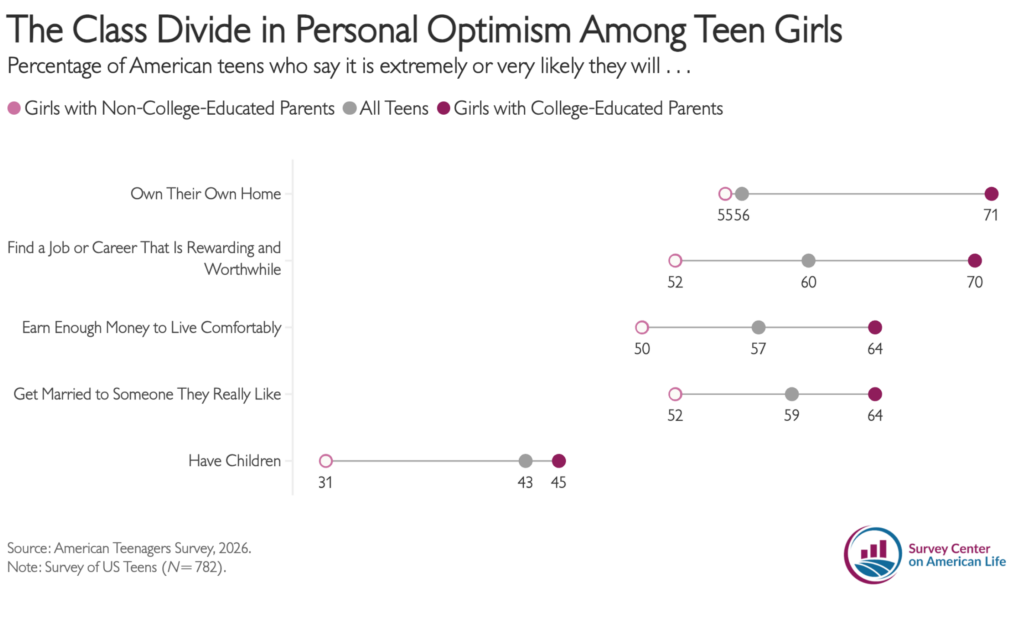
Meanwhile, teen girls, particularly those from more educated backgrounds, stand out for their optimism in their expectations of meeting various life goals. Seventy-one percent of teen girls raised by college-educated parents believe they are likely to own their own home. Only about half (53 percent) of teen boys with college-educated parents and fewer than half of all teens in less educated households say the same.
A similar pattern emerges with career aspirations and financial security. Seven in 10 teen girls with college-educated parents say they are likely to find a rewarding career. Sixty-two percent of teen boys with college-educated parents and only about half (52 percent) of teen girls raised by parents without college degrees express this view. Close to two-thirds (64 percent) of teen girls with college-educated parents say they are likely to earn enough money to live comfortably, an opinion 56 percent of their male peers and half of teen girls whose parents do not have college degrees hold.
The differences are evident when it comes to personal life goals as well. Teen girls raised by parents with college degrees are more optimistic that they will get married and have children than are their peers who do not have college-educated parents. Close to two-thirds (64 percent) of teen girls with college-educated parents believe they are likely to be happily married someday; only about half (52 percent) of teen girls raised in less educated households are confident they will marry someone they are fond of. When it comes to starting a family, 45 percent of teen girls raised by college-educated parents say they are likely to have kids someday, compared with only 31 percent of their peers with non-college-educated parents.
How Essential Are Marriage and Parenthood?
Teenagers are likely skeptical about marriage and parenthood in part because many believe they are not necessary for living a good and meaningful life. Less than half (46 percent) of teens say getting married and having kids are essential to living a successful life. Fifty-three percent do not believe these are important. Teen boys are somewhat more likely than teen girls to believe marriage and parenthood are critical components of a good life. Fifty-three percent of teen boys—including 58 percent of older teen boys—say getting married and having children are an essential part of having a successful life, but fewer than four in 10 (39 percent) teen girls agree.
The future can feel far off for teenagers still navigating the complicated social dynamics of high school and dealing with homework and extracurricular demands. Asked about their own future, America’s teenagers had some sense of what a good life might look like. For many teens, it included financial security and a personally rewarding or lucrative occupation. For some teens, a partner or spouse was part of this future, but few teenagers explicitly mentioned starting their own family.
A 14-year-old girl in Michigan said, “I would have a great job being a nurse or a hair stylist. I probably wouldn’t have any kids but I would have two dogs. I would live in a rich neighborhood and spend my spare time with my friends.”
A 14-year-old girl in Wisconsin talked about a future that included hobbies and personal interests with a spouse, but her ideal life did not include having children: “Married, no kids, good well-paying job that I enjoy. Own a nice house in the country with horses and animals. Traveling, doing arts, playing with animals.”
A 14-year-old girl in California mentioned wanting to achieve a balance of work and relationships: “My ideal life is to have a stable job and to be together with someone I love. I imagine spending my time half with work and the other half with my family. I hope in the future I can achieve a good work home balance.”
Teen boys shared similar scenarios that included both work and time for family, but fewer mentioned children, especially younger teen boys. A 15-year-old boy in Texas reported, “I imagine myself in a nice, cozy house not too luxurious but pretty. I imagine myself with a kind wife who loves me. I imagine myself doing audio work and working on music.”
A 14-year-old boy in Oklahoma described being “in the country, decent amount of land, working for my own electrical company, and fishing every weekend.”
Although polls have shown a sharp decline among teen girls in starting their own families, girls were somewhat more likely than teen boys to include kids in their ideal future. A 17-year-old girl in Florida said, “At 30 I imagine myself having 4 kids, married to my husband, living in a home I built myself. Spend as much family time as I can with my family. Maybe living in a different city or country.”
A 14-year-old girl in South Carolina reported, “In 16 years I hope to see me being successful and hopefully have a career in the medical field. I also hope to have [at] least one or two kids.”
Overall, nearly every teenager mentioned personal relationships, even if it was somewhat more abstract than their professional goals. Notably, teen girls were more likely than teen boys to mention a career or job. Teen girls were also much more likely to include their personal hobbies and interests in their ideal lives. Still, boys and girls alike frequently mentioned partnership or marriage. And teens raised in more religiously active households were significantly more likely to mention marriage and children as part of their ideal life.
Conclusion
Most teenagers do not have grandiose aspirations for their lives but rather seek to prioritize stability and familiarity. Coming of age at a time of so much technological change and amid cultural upheaval and political uncertainty informs their current outlook. Yet it is their technology use that makes their formative experiences so distinctive from previous generations.
Although teenagers are starting to recognize the problem of excessive screen time, many are not actively trying to set limits for themselves. This may not be an issue for everyone. Moderate social media use does not appear to jeopardize teenagers’ well-being, but heavy users report lower satisfaction with their lives. Schools and parents can limit social media access, but there is an emerging educational divide in teen technology use. Whether the technology is video games or social media, heavy users are more concentrated in noncollege households, a trend that may perpetuate the disadvantages these teens already face.
About the Author
Daniel A. Cox is the director of the Survey Center on American Life and a senior fellow in polling and public opinion at the American Enterprise Institute. Under his leadership, the center focuses on public opinion and survey research on a variety of topics, including the emerging gender divide among young adults, dating and relationships, and social connection. Cox is the author of Generation Uncoupled: America’s New Gender Divide and the Crisis of Human Connection (forthcoming), a book exploring the increasingly complex relationships between young men and women and the decline of dating and long-term partnerships.
Survey Methodology
The survey was conducted by NORC at the University of Chicago on behalf of the American Enterprise Institute’s Survey Center on American Life using NORC’s AmeriSpeak Panel for the sample source. AmeriSpeak is a probability-based panel designed to be representative of the US household population, including all 50 states and the District of Columbia.
AmeriSpeak Teen members (age 13 to 17) are recruited via their parent or legal guardian who resides in the same household and is already a part of the AmeriSpeak Panel; therefore, the AmeriSpeak Teen Panel has the same probability-based design as the adult household panel. The survey sample consisted of all active Teen Panelists; from the 1,400 individuals invited to the survey, NORC collected 782 complete interviews. The survey was offered in English only and was self-administered by respondents online. Interviewing was conducted between January 20 and February 16, 2026.
Weighting was accomplished in three separate stages. First, weights were developed for all panel members to account for their probability of selection into the sample of panel recruits, panel recruitment nonresponse adjustments, and post-stratification adjustments of the recruited panel to match population benchmarks.
Second, sampling weights were developed for the study sample selected from the panel to account for their selection probabilities under the sample design; these base weights are a product of the AmeriSpeak Panel weights and the inverse of the selection probabilities associated with sample selection from the panel.
Last, final weights were developed for all completed cases of the study. The final weights are adjustments of the base weights to address survey nonresponse through a weighting class method, with the weighting classes defined by age, race or ethnicity, sex, and parent’s education. Raking adjustments were then applied to the nonresponse-adjusted weights to align the survey sample to specific population benchmarks drawn from the March 2025 Current Population Survey. The final weights may be trimmed to reduce the influence of extreme weights on survey estimates.
The use of survey weights in statistical analyses ensures that the demographic characteristics of the sample closely approximate the demographic characteristics of the target population. The margin of error for the survey is +/−4.79 percentage points at the 95 percent level of confidence. The design effect for the survey is 1.87.
Notes
[i] This represents social media use among teenagers who reported using social media daily.
[ii] Kevin Mahnken, “Long-Term NAEP Shows Growth for 9-Year-Olds, More Disappointment for Teens,” The 74, June 10, 2026, https://www.the74million.org/article/long-term-naep-shows-growth-for-nine-year-olds-more-disappointment-for-teens/.
[iii] Nation’s Report Card, “NAEP Long-Term Trend Assessment Results:
Reading and Mathematics; Student Experiences,” https://www.nationsreportcard.gov/ltt/reading/student-experiences/?age=13.
[iv] Daniel A. Cox, The State of American Friendship: Change, Challenges, and Loss, American Enterprise Institute, June 8, 2021, https://www.americansurveycenter.org/research/the-state-of-american-friendship-change-challenges-and-loss/.
[v] Teens were asked whether they have spent time on an inexhaustive list of social media apps in the past week.
[vi] Michael T. Nietzel, “Women Continue to Outpace Men in College Enrollment and Graduation,” Forbes, August 7, 2024, https://www.forbes.com/sites/michaeltnietzel/2024/08/07/women-continue-to-outpace-men-in-college-enrollment-and-graduation/.
Generation Uncoupled

Generation Uncoupled: America's New Gender Divide and the Crisis of Human Connection
Buy NowRelated Materials
Survey Reports