

Our Most Noteworthy Survey Findings of 2025

American Storylines
Merry Christmas! It’s hard to believe that 2025 is coming to a close. It was a taxing but rewarding year. I’ve mostly finished work on my book, Generation Uncoupled, which is tentatively scheduled for release in fall 2026. Although book research and writing have taken up much of my energy this year, we managed to publish three major survey reports and lots of newsletters. We have several exciting projects slated for 2026, and I look forward to sharing those results with you in the year ahead.
Before I share our top five survey findings of 2025, I wanted to highlight some of my favorite news stories that featured our research. One of the most rewarding aspects of doing public opinion polling is that I get to regularly engage with some exceptionally smart, motivated, and curious journalists. Our work appeared in more than 250 major news stories this year! Here are a few of my favorites:
Jesus Bot Is Always on Demand (for a Small Monthly Fee) by Jessica Grose for The New York Times
I don’t subscribe to many non-Substack newsletters, but I make an exception for Jessica Grose’s New York Times newsletter covering family, politics, and culture. Her recent piece on religious chatbots introduced relational and religious issues that I had never considered, despite how much time I spend thinking about these topics.
“Jesus then says to ‘celebrate wins,’ and reminds me of Matthew 6:33: that I seek God first. Then he serves up an ad for Amazon and another for a game called Royal Match, because I only have the free version of the app. Jesus is not the only biblical persona you can chat with on Text With Jesus, but many of the characters are locked behind the paywall; Jesus comes for free, but Judas is going to cost you.”
Why we actually should worry about Gen Z by Christian Paz for Vox
I’ve known Christian for years and have talked with him for stories on numerous occasions. I admire his thoughtfulness and openness in engaging with unpredictable survey results. When he asked to do a formal interview on the subject of Gen Z, I immediately agreed.
“Some of the most hedonistic, self-serving, and destructive behavior that ought probably to be judged as inappropriate or harmful gets caught up in the same ethos of, well, we need to be accepting of people who make different decisions. And so part of what Gen Z’s wrestling with now is where to draw some of those lines.”
What Republican Men Think About Trump and Masculinity by Claire Cain Miller for The New York Times
One of the first newsletters I wrote in 2024 argued that Trump was poised to do well with young male voters in the upcoming election. That prediction came to pass. A majority of young male voters supported Trump in 2024, something they did not do in either of the previous election. In a follow-up article written in early 2025, Claire Cain Miller explored what Trump-voting men were actually after. It’s not simply a return to 1950s gender roles.
“This idea that young people in particular want to go back to some golden era of masculinity misses the mark pretty significantly. That’s not a world they know. The world they know is the expectation that men and women are equal and treated equally, and what they’re increasingly concerned about is an uneven playing field tilted against them.”
America is becoming a nation of homebodies by Diana Lind for The Washington Post
In an op-ed for the Washington Post, Johns Hopkins Visiting Fellow Diana Lind argues that rising rates of loneliness and social isolation are not simply due to social media, but the natural consequence of fewer of us leaving our homes.
“Only 54 percent of Americans in 2025 have a ‘third place’ they frequent, such as a coffeehouse or bar, down from 67 percent in 2019, and that number is still declining even after the pandemic ended. The place where everyone knows your name — the bar from ‘Cheers,’ the diner from ‘Seinfeld,’ the coffeehouse from ‘Friends’ — is more and more an anachronism.”
Teens Are Forgoing a Classic Rite of Passage by Faith Hill for The Atlantic
Faith Hill has written some of my favorite pieces at The Atlantic this year. Her articles on dating and relationships are always well-researched, insightful, and appropriately nuanced. They also convey a degree of empathy that is too often absent in writing on these topics.
“The young-love recession, in other words, might reflect a real shift in how comfortable Americans are, on the whole, with emotional intimacy. Generational researchers have described Gen Z as a cohort particularly concerned with security, averse to risk, and slow to trust—so it makes sense that a lot of teens today might be hesitant to throw themselves into a relationship.”
Top Five Findings of 2025
Even after 20 years of doing this work, I’m still surprised at what polls can reveal when you ask the right questions. Below are some of the most noteworthy findings from our research this year. Some of these results build on past research, while others take an entirely new direction.
1. An Above Average Generation

From: Individuality and Moral Behavior: A Generation Divide on Moral Judgements and Self-Expression
I dubbed this our “Lake Woebegone” chart based on Garrison Keillor’s fictional Hamlet, where “all the women are strong, the men are good looking, and the children are above average.” Earlier this year, I began to wonder whether the combination of intensive parenting strategies, smaller families, and rising investments in extracurricular activities for children had left an entire generation believing they possessed exceptional qualities. In our latest survey, we included a question about whether Americans believe their parents thought they were average when they were growing up. Views varied considerably by age: young adults were most likely to reject this statement, while the oldest were most likely to affirm it. From our recent report:
“A majority (54 percent) of seniors agree with the statement: ‘Growing up, my parents thought I was mostly average.’ Forty-five percent disagree. Young adults are far less likely to believe this: only 36 percent grew up believing their parents thought they were average, while 60 percent say they did not think their parents viewed them as average.”
2. Young Men Want Greater Restrictions on Porn
From: America’s Cultural Crossroads: Enduring Discontent, Rising Disconnection, and an Uncertain Future
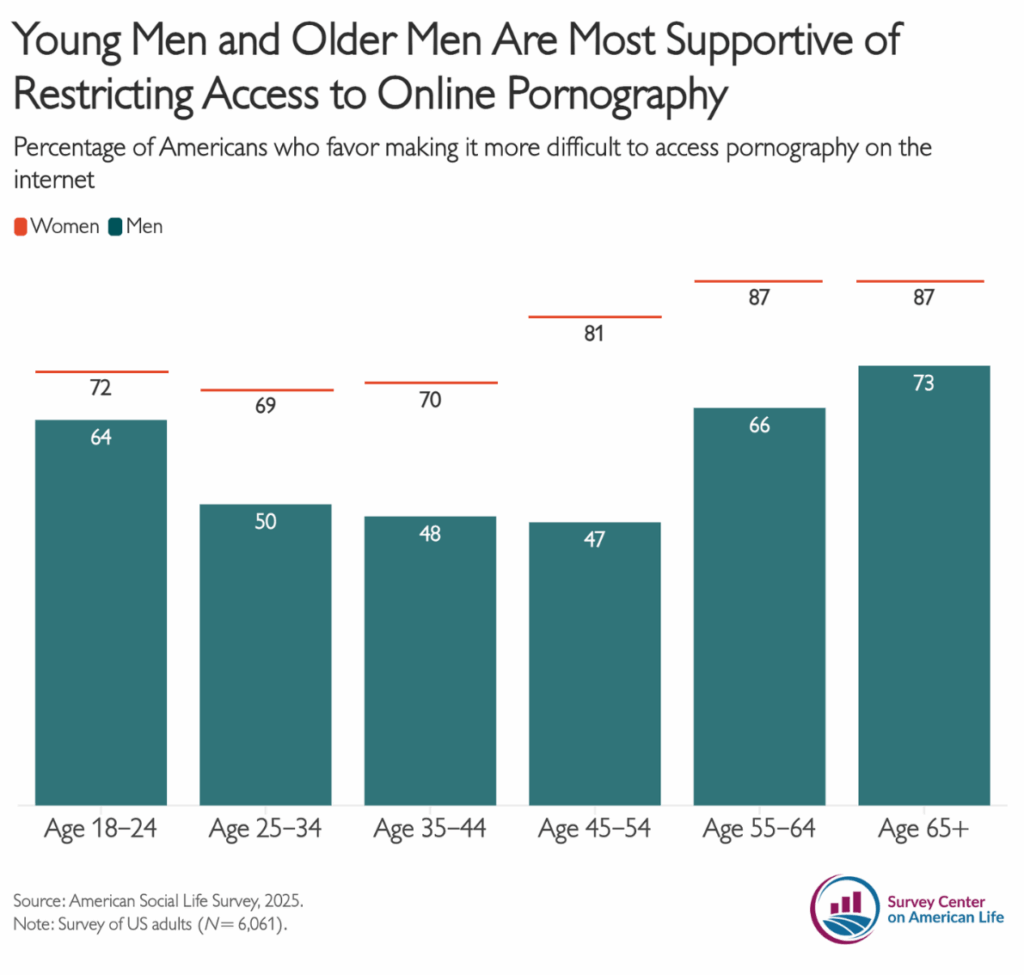
Earlier this year, our 2025 American Social Life Survey revealed that young men were starting to turn against pornography. Previous surveys had consistently found that young men were more permissive when it came to pornography use and wary of limiting access. In the age of OnlyFans and the proliferation of online pornography, young men’s views are starting to change. Only a year ago, I wrote a newsletter titled “The Pornography Problem” that showed young men were most accepting of its use. Now, the youngest men (age 18 to 24) are among the strongest proponents of limiting access.
“Despite the modest increase in support overall, some Americans have grown far more supportive of restricting pornography. Young men have become much more amenable to reducing access to it. In 2013, young men were divided—about half (51 percent) favored making it more difficult to access pornography online, while just about as many (40 percent) opposed this policy. Today, six in 10 young men say they believe we should make accessing pornography online more difficult.”
3. The Link Between Religion, Family, and Fertility

From: Is America’s Religious Decline Responsible for Falling Birthrates?
Lots of polls, including our own, have found that young women have grown more circumspect about marriage and children. These rising reservations about starting families have led some to speculate whether the United States might be on the verge of a national fertility crisis. But for those claiming that this is largely attributable to political ideology, waning religious influence may be a more potent explanation. Americans raised in religious families are more likely to get married and start families of their own. As I wrote in a recent October newsletter on the subject:
“Young adults raised in religious households are more likely to report that their parents stressed the importance of marriage. Fifty-nine percent of young adults who attend religious services weekly say their parents talked at least occasionally about the importance of finding a partner or getting married. Only 38 percent of young adults who seldom or never attend religious services had the same experience.”
4. The Social Factor of Divorce
From: Why Married Couples Stay Together
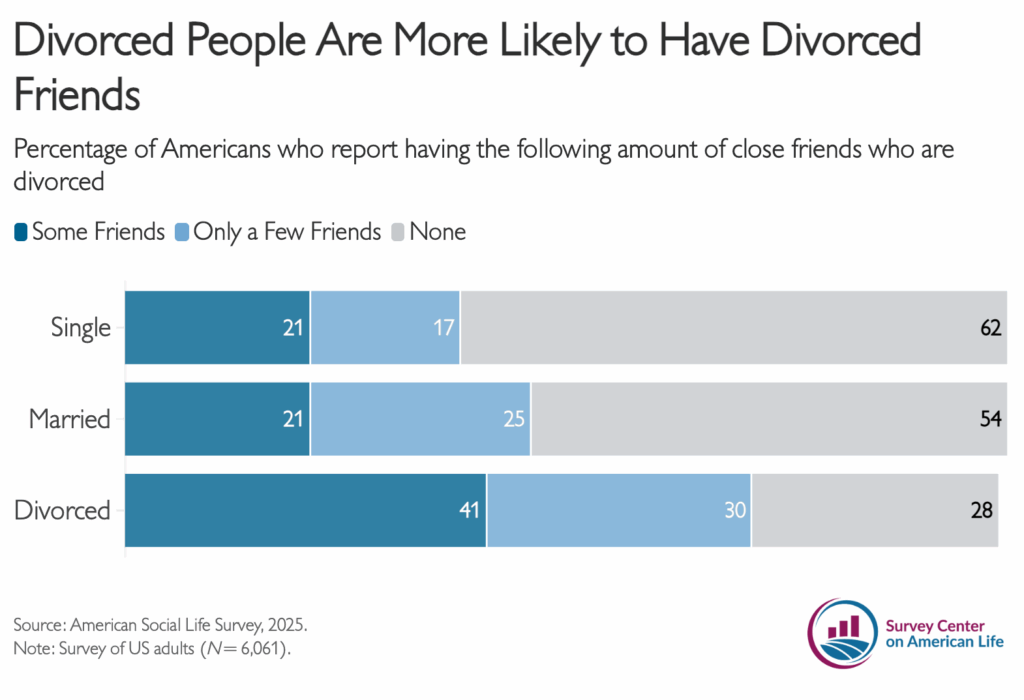
Fewer Americans get divorced today, but it’s still a fairly common occurrence and the subject of considerable interest. One factor that is often overlooked when exploring marital outcomes is the broader social environment. It turns out that Americans who get divorced have many more close friends who are divorced as well.
“If you are divorced, you are far more likely to have a close friend who is also divorced. Forty-one percent of divorced Americans report that they have at least some close friends who are divorced as well. In contrast, only 21 percent of married Americans have at least some close friends who are divorced. Most married Americans do not have any divorced friends.”
“Our surveys also show that marital satisfaction is measurably lower among those with divorced friends––a possible indication of future marital troubles. Close to half (46 percent) of married Americans with no close friends who are divorced report being “completely satisfied” in their relationship, compared to 34 percent who have at least some close friends who are divorced.”
5. America’s Religious Revival That Wasn’t

From: The Illusion of America’s Religious Revival
Last year, my colleague, Kelsey, and I wrote a newsletter about the rapid deterioration of religious identity among young women. Although young women had consistently recorded higher rates of religious involvement than young men, the pattern was beginning to reverse. Young men were no longer less religious than young women. This notable trend led to a spate of news stories speculating about (or, in some cases, pronouncing) the emergence of a religious revival spurred by young men. The problem was these claims were not backed up by reputable polling. This year, we showed that Pew’s 2024 Religious Landscape Survey provides additional evidence challenging these narratives. Young women continue to abandon their formative religious commitments, while young men’s religious commitments have held steady at historically low rates.
“While secular identity has plateaued among young men, it continues to rise among young women. From 2014 to 2024, young women became far less religious: 43 percent identify as religiously unaffiliated today compared to 33 percent a decade earlier. Young men showed almost no change over the same time period.”
I also noted that this pattern was not limited to religious identity.
“Young women show a pronounced decline in the importance of religion in their lives. In 2007, 82 percent of young women said religion was somewhat or very important to them personally. That dropped to 57 percent by 2024 (a 25-point decline). Young men have experienced a dramatic decline as well, but not quite as steep.”
Read More on American Storylines
Generation Uncoupled

Generation Uncoupled: America's New Gender Divide and the Crisis of Human Connection
Buy NowSurvey Reports