

CommentaryJanuary 4, 2022
Why The Republican Party Isn’t Concerned With Popularity
Despite the fact that the GOP is quite unpopular and that much of its current agenda, the party is in an enviable position heading into the 2022 midterm elections and beyond. Why?
Short ReadsDecember 20, 2021
Churches as Political Communities
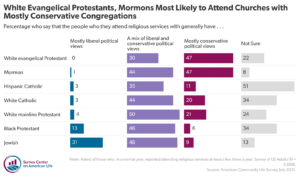
We have long known that churches and religious congregations are important sources of political information and influence. Now, a new report finds that many Americans perceive their congregation as sharing a mix of liberal and conservative beliefs. However, certain traditions are much more likely to have uniformly conservative congregations. Nearly half of White evangelical Protestants (47 percent) and Mormons (47 percent) say that the people they attend religious services with have mostly conservative
Short ReadsDecember 16, 2021
The Importance of Work Friends
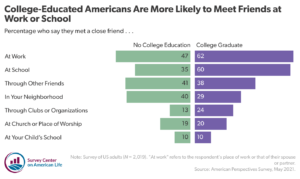
Americans who never attended college are experiencing a rapid social decline—they have fewer close friends and considerably less social support. Part of the reason may have to do with the fact that Americans without a college education have fewer workplace friends. Sixty-two percent of college graduates have a close friend they met through work, compared to 47
Short ReadsDecember 16, 2021
The Diverging Trajectories of Same-Sex Marriage & Abortion
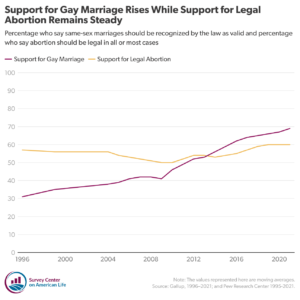
In 1996, Americans were far more supportive of legal abortion than allowing gay and lesbian couples to marry. Only 31 percent of Americans favored same-sex marriage in the mid-1990s while nearly six in 10 (57 percent) said abortion should be legal in at least some circumstances. Today, nearly seven in 10 (69 percent) Americans believe
Short ReadsDecember 16, 2021
A Belief and Belonging Paradox?
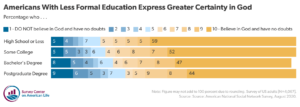
Americans with less formal education tend to express greater certainty about their belief in God. Fifty-nine percent of Americans without a college education say they are certain God exists. Only 44 percent of those with post-graduate education say the same, although they are slightly more likely to express certainty that God does not exist. Despite

Survey ReportDecember 13, 2021
The College Connection: The Education Divide in American Social and Community Life
Despite concerns about rising student debt, the economic value of a college education has never been clearer. College graduates are more socially connected, civically engaged, and active in their communities. College graduates have more extensive systems of social support, a larger number of close friends, and feel lonely and isolated less often than those without a degree.

CommentaryNovember 29, 2021
Why Crime Likely Won’t Be An Issue In The 2022 Midterms
Violent crime is up. Data from the FBI found that the murder rate increased nearly 30 percent in 2020. And homicides continue to rise in 2021 as well, if not by quite as much. Americans have noticed.

Survey ReportOctober 20, 2021
Public Places and Commercial Spaces: How Neighborhood Amenities Foster Trust and Connection in American Communities
The COVID-19 pandemic forced Americans across the country to reconsider their residential priorities. Today, many Americans would prefer to live in small towns or rural areas rather than denser urban neighborhoods, and they are more likely to prioritize personal space over access to community amenities. The report investigates the physical and social features of local communities that Americans value most.

Survey ReportSeptember 22, 2021
Controversy and Consensus: Perspectives on Race, Religion, and COVID-19 in Public Schools
At a time of rapid cultural change, Americans continue to debate what students should learn about race, sex, and religion. While the public broadly supports students learning about America’s complicated racial legacy, political divisions persist. Democrats are far more willing to defer to teachers, while Republicans want a much larger role for parents in education decisions.
CommentaryJuly 25, 2021
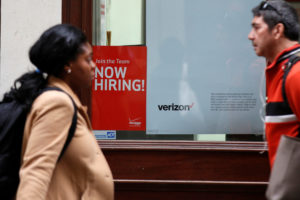
We Asked Hundreds of Unemployed Americans What’s Keeping Them Out of Work — It’s Not Unemployment Benefits
The Survey Center for American Life’s new survey shows a difference in needs between the pandemic unemployed and the chronically unemployed.