
Friend Zone

Featured Data February 22, 2023

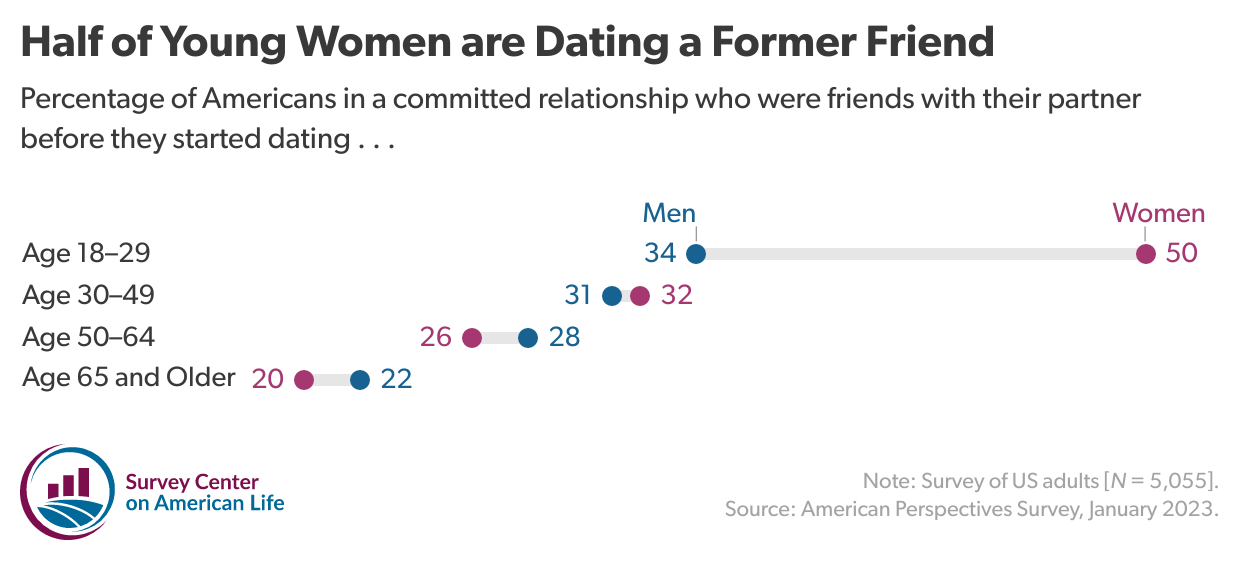
Dumbbell plot showing percentage of Americans in a committed relationship who were friends with their partner before they started dating ages 18 and up

Dating apps have become an undeniable part of the romantic landscape, but more young people opting for a different strategy of finding a partner: Their friends. A new report, “From Swiping to Sexting: The Enduring Gender Divide in American Dating and Relationships” finds that young adults are much more likely than older Americans to say their partner or spouse was a friend first. This trend is even more common among young women. Half (50 percent) of young women who are in a relationship are dating someone with whom they were friends before they started dating.  

Advantages to dating your friends include; relationships starting from a place of mutual care, shared personal history, and an ability to trust the person you are dating and for young women specifically, safety. Seems like being in the “friend-zone” might not be as permanent of a position as many young men might think.  

Generation Uncoupled

Generation Uncoupled book

Generation Uncoupled: America's New Gender Divide and the Crisis of Human Connection

Buy Now

Survey Reports

Daniel A. Cox
July 23, 2026

A Digital Divide in American Adolescence: Gender, Class, and the New Teenage Experience

If teenage years once represented a time of rebellion, teenagers’ lives today are marked less by pushing boundaries and more by building their own. Many teenage experiences are less common than they once were—dating, working a part-time job, and experimenting with drugs and alcohol are less common experiences. The 2026 American Teenagers Survey from the

Daniel A. Cox, Jae Grace, Avery Shields
April 27, 2026

Strangers Next Door: The Decline of Neighborhood Socializing and the Class Divide in Belonging

Acknowledgment The American Enterprise Institute’s Survey Center on American Life is grateful to the John S. and James L. Knight Foundation for its generous support of this research. As Americans spend more of their time online, the neighborhood—once a primary physical location for real-world socialization—is playing less of a central role than ever before. Since