

The Gender Divide in Youth Political Affiliation
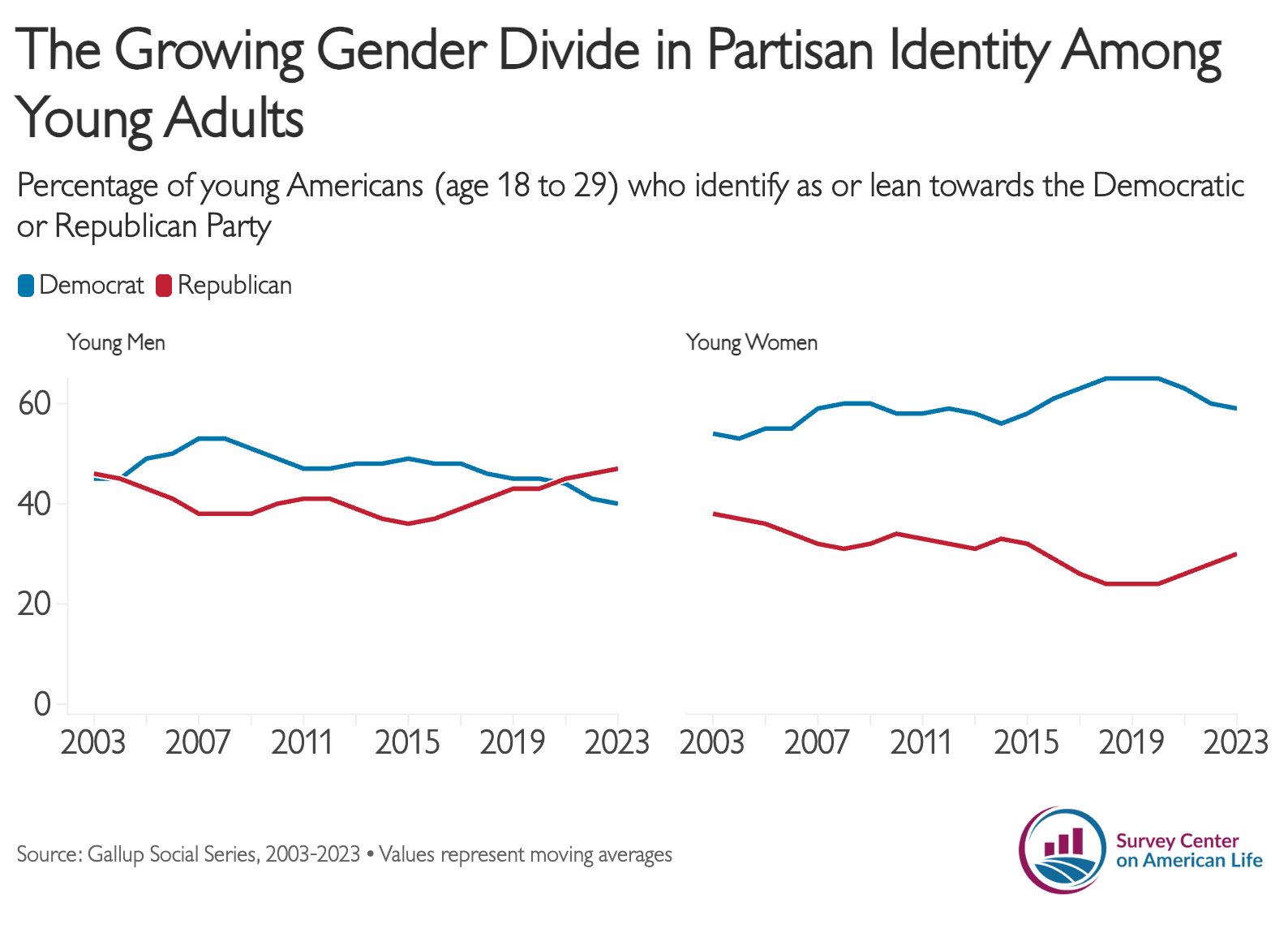
The 2024 election revealed major weaknesses in the Democratic Party’s coalition. Young voters, a reliable Democratic constituency for the last two decades, backed Harris over Trump by a relatively narrow margin. According to AP VoteCast, Donald Trump lost the youth vote by only 4 points (47 vs. 51 percent), driven by his strong showing among young male voters.
But rather than revealing a new fault line, the 2024 election reflected the growing gender divergence in youth political identity. Over the last two decades, Gallup polling has shown that young men have been moving steadily away from the Democratic Party. Democratic affiliation has dropped 16 points since 2008. But much of this decline has occurred since 2016. Nearly half (51 percent) of young men identified as Democrat or leaned towards the Democratic Party, but that fell to 38 percent by 2023. Now, for the first time in over a decade, more young men are identifying as Republicans rather than Democrats.
The politics of young women have followed a very different trajectory. Young women became more Democratic during the first Trump administration—two-thirds (67 percent) identified as Democratic or leaned towards the party in 2019. Since 2020, young women’s Democratic identity dropped by a nine-point margin, reflecting dissatisfaction with the Biden presidency. In 2023, a majority (56 percent) of young women are Democrats, a near 20 points higher than young men.
Generation Uncoupled

Generation Uncoupled: America's New Gender Divide and the Crisis of Human Connection
Buy NowSurvey Reports