
More Americans View the Democratic Party as Liberal
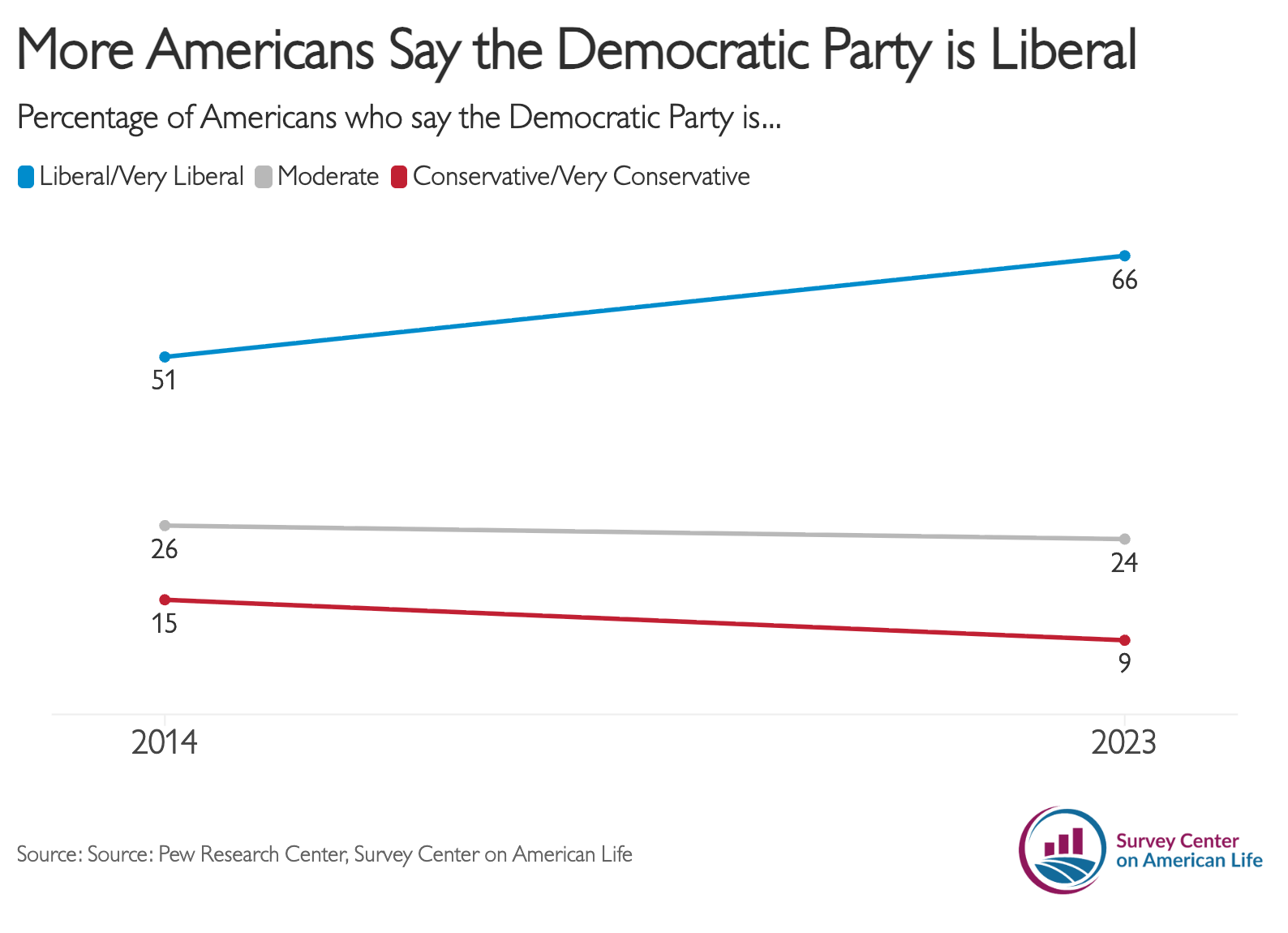
The Democratic Party’s image has changed rapidly over the past decade. Today, nearly two-thirds of Americans perceive the Democratic Party as “Liberal” or “Very Liberal,” a 15-point increase since 2014. Nearly a quarter of Americans still view Democrats as moderate, while slightly fewer say the party is conservative. Notably, 37 percent of Americans say the Democratic Party is very liberal.
Some groups have swung dramatically in their views of the Democratic Party. No group has undergone a more rapid shift than Hispanics. A majority (55 percent) of Hispanics believe the Democratic Party is liberal, a 22-point increase over the past decade. In 2014, only one in three (33 percent) Hispanics thought of the Democrats as a liberal political party. White Americans have come to view the Democratic Party as more liberal as well. Nearly three-quarters (74 percent) say the party is liberal compared to 60 percent who said so roughly ten years earlier. The views of Black Americans have barely changed at all. Only 40 percent of Black Americans say the Democratic Party is liberal, compared to 37 percent who said this in 2014.
Given that a similar number of Americans believe the Republican Party is conservative—72 percent—how much of this changing perception is an electoral liability for the Democrats? Quite significant as it turns out. Most Americans who view the party as liberal have a negative have an unfavorable opinion of it. But being viewed as “very liberal” is much more problematic. Eighty-six percent of Americans who say the Democrats are “very liberal” have an unfavorable view of the party.
Generation Uncoupled
Generation Uncoupled: America's New Gender Divide and the Crisis of Human Connection
Buy NowSurvey Reports