

Religious Americans Agree on Limiting In-Person Services, Split on Returning to Worship as Usual
Voter Study Group
Houses of worship across the United States have closed their doors to help stop the spread of COVID-19. These closures have occasionally become cultural flashpoints — with some religious leaders holding service in defiance of state and local health ordinances. As states move to reopen and ease many of the restrictions meant to fight the pandemic, majorities of Americans remain concerned about COVID-19, and it’s unclear what in-person religious services will look like.
New data from Democracy Fund + UCLA Nationscape shows areas of alignment and division on restoring religious conventions during the pandemic.
Most Americans believe state and local governments should have the authority to shutter places of worship temporarily to reduce transmission of the coronavirus. In Nationscape data collected between April 23 and April 30, more than three-quarters (77 percent) of the public said state and local governments should be able to limit people’s right to attend religious services in person in order to limit the spread of COVID-19. Fewer than one in four (23 percent) Americans said that the right to attend religious services in person should be protected, even if it increases the risk of people exposing themselves and others to the disease.
Further, there was widespread agreement across major religious traditions in support of governmental authority to curb religious gatherings. A majority of white evangelical Protestants (60 percent), white mainline Protestants (74 percent), white Catholics (75 percent), black Protestants (76 percent), members of non-Christian religious traditions (76 percent), Hispanic Catholics (82 percent), and religiously unaffiliated Americans (85 percent) believe government officials have the power to limit Americans from attending religious services.
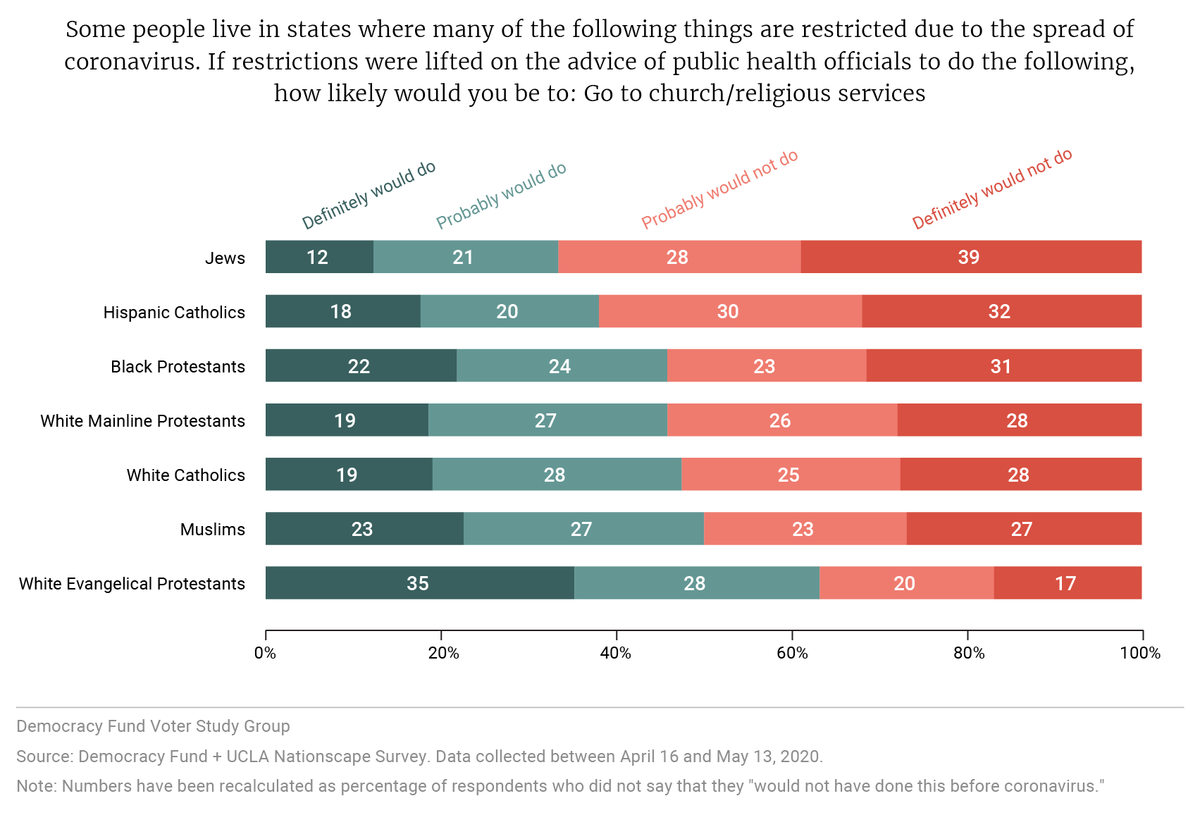
Even if restrictions were lifted, not all Americans are ready to attend in-person services. In Nationscape data collected between April 16 and May 6, fewer than half (48 percent) of religiously affiliated Americans who attended services before the COVID-19 outbreak say they would definitely or probably attend religious services even if public health officials deemed it safe.(1)
On this question, there are striking differences across religious traditions. More than six in ten (63 percent) white evangelical Protestants who attended services before the pandemic say they would likely return to the pews if public health officials advised lifting those restrictions. Fewer Muslims (50 percent), white Catholics (47 percent), white mainline Protestants (46 percent), black Protestants (46 percent), Hispanic Catholics (38 percent), and Jews (33 percent) who participated in worship services previously say they would be likely to return. At least half of those belonging to these religious groups say they are not likely to attend a worship service even if public health officials endorse lifting the restriction.
(1) Data was combined over several weeks to make estimates for smaller religious groups possible.
As more states and localities begin to open up in various ways, relatively few members of the public dispute that the government should be able to limit in-person services in order to combat COVID-19. But even with increased opportunities to head back to formal, in-person worship services, public health concerns loom large in the minds of many Americans. At this stage, many are still weighing the risk that comes with participating in activities that put them in close contact with others. For houses of worship, this means things may not return to normal even when their doors are open again.
Generation Uncoupled

Generation Uncoupled: America's New Gender Divide and the Crisis of Human Connection
Buy NowSurvey Reports